Manufacturer catalogue image - please note that pre-release images may be CAD renders or CGI/AI images rather than photographs
Prototype Eras
Era 10 (2005 to 2015) Rebuilding of the Railways
Era 11 (2016 to 2026) The Last Days of Privatisation
Manufacturer description
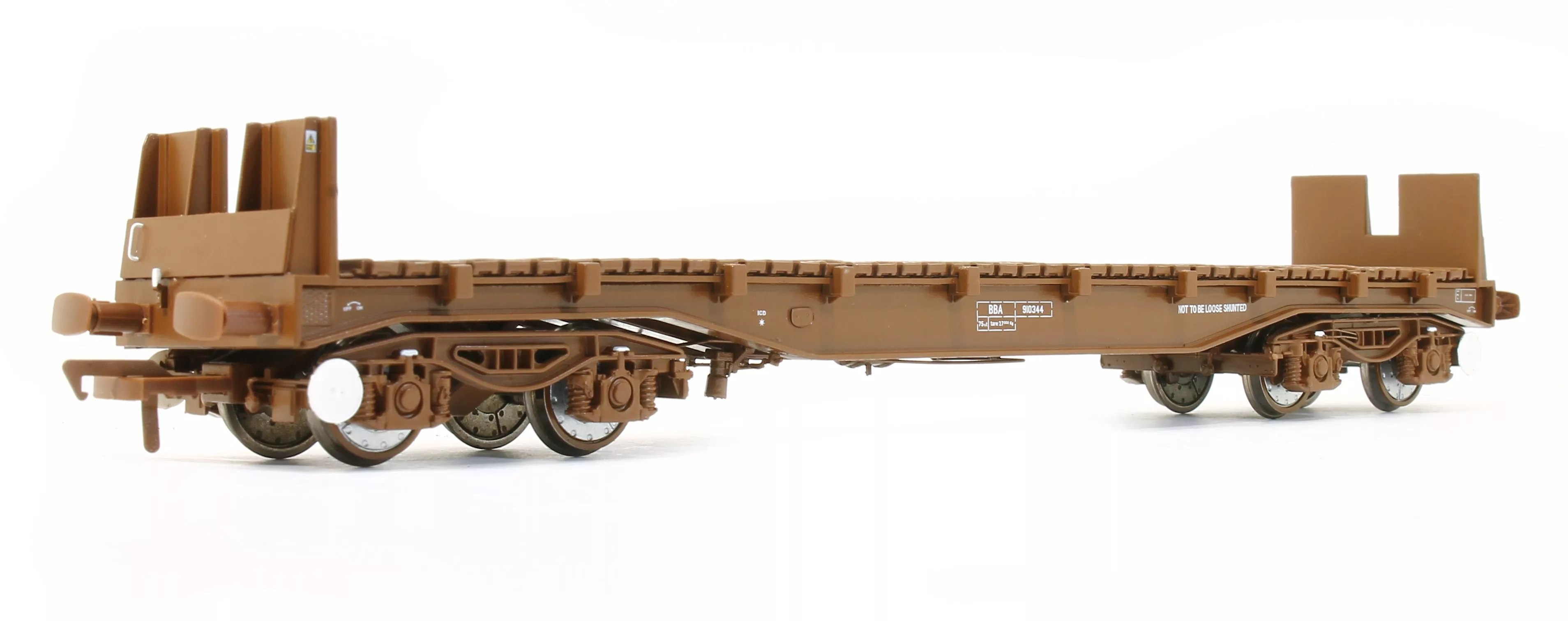
Plain Brown BBA Bogie Steel Wagon No.910344
Built between 1973 and 1981, the BBA was a slightly longer version of the earlier BAA steel wagon but with a reduced 75 tonne capacity. The heavily constructed long steel carrier was designed to carry ingots, slabs, long lengths of steel, steel coil, and billets.
A prototype of the design was built at BR Shildon in 1973 and was 10ft longer than the earlier BAA type, with deeper solebars. Production followed at BR Ashford with over 500 wagons being built to two design codes: BB001B and BB001C.
Following production over an eight year period the wagon type became the principal steel carrying wagon on British Rail.
Early batches of the BBA were delivered in BR bauxite brown livery with black bogies, while the final batch of wagons wore the then new Railfreight black livery with red ends and side labels.
Once these wagons had entered service across the BR network they would usually be found mixed in with other types in block trains often with BAA wagons. The BBA could be seen in South Wales, the Midlands, the north east of England and Scotland. Operations were on trunk routes between steel production and finishing locations and industrial users.
The BBA has seen several modifications during its lifetime, primarily to allow the easier loading and unloading of strip coils. Variations have included the removal of the ends and the fitting of 5 transverse coil cradles, removal of the ends and floor and the fitting of coil boxes (BLA) and the fitting of telescopic sliding covers (BWA). Other TOPS codes applied have been BEA, BIA, BRA, BUA and BXA.
Between 1994 and 1995 over 250 BBA wagons were modified with the removal of the ends and floor and the fitting of coil boxes and recoded BLA. This was for steel strip coil traffic in south Wales for Dee Marsh, Llanwern, Trostre, and Ebbw Vale.
The BBA and shorter BAA have been the mainstay of the heavy steel carrying fleet since their introduction in the mid-1970s and can still be seen in service today.
Catalogue listing
Supplier Links


Supplier links are provided for your convenience and do not guarantee that the product is currently available. RailwayModels.uk is not a representative of these suppliers, but may receive a commission when purchases are made through links on this page.