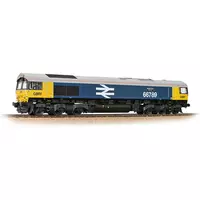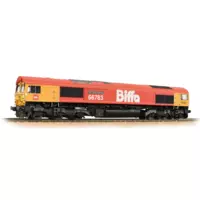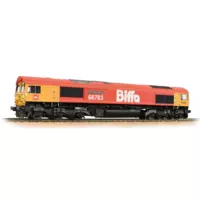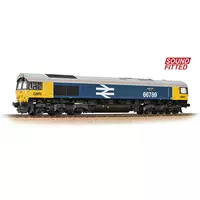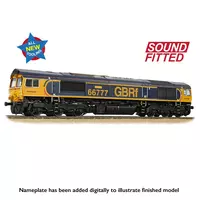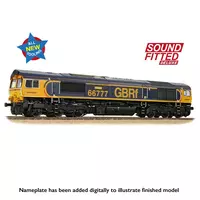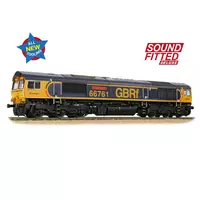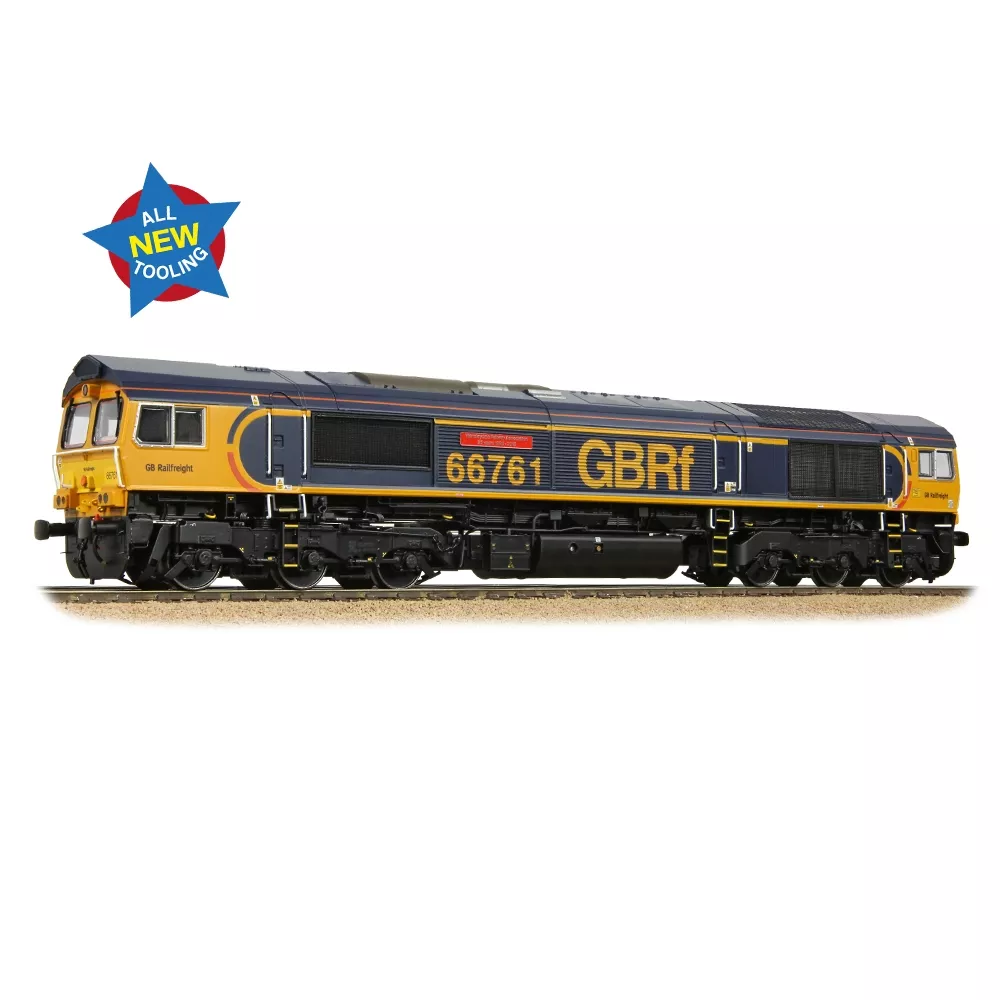
Manufacturer catalogue image - please note that pre-release images may be CAD renders or CGI images rather than photographs
Prototype Era
Era 9 (1995 to 2004) Initial Privatisation
Manufacturer description
The Class 66 Diesel Locomotive revolutionised the British rail freight landscape when the first examples arrived in 1998, and more than a quarter of a century later, the type remains at the forefront of freight operations the length and breadth of the country. Now, we are delighted to present the all-new Bachmann Branchline OO Scale Class 66 which has been designed from the rails up, capturing this modern icon like never before.
The new Class 66 combines a high-fidelity, injection-moulded bodyshell with a heavy, diecast chassis to which separate main frames are fitted. A multitude of individual parts are then added, manufactured in both metal and plastic, to capture every element of the prototype. The HTCR radial bogies are reproduced in miniature using multiple components, with many separately added details, resulting in these true to life replicas which interface neatly with the locomotive’s frames for an authentic appearance and accurate ride height. The separate axle heads that each rotate smoothly and reliably when the model is moving, mimicking this characteristic feature of the prototype, is the finishing touch.
The colourful liveries of modern operators present some challenges when it comes to decorating our models, but with extensive research, close collaboration with the operators themselves and decades of experience producing beautifully finished models, we are able to replicate every detail. Paintwork is applied with a rich, uniform finish using original specification colours, which is then adorned with logos, typefaces and graphics, all reproduced authentically using multi-stage printing techniques to produce a model with the finest of looks.
Meanwhile, ‘under the bonnet’ the new Class 66 boasts a high specification that utilises the latest advancements in model railway technology. A full lighting suite includes directional lights, with day and night mode and stabling mode, along with cab lights and machine room lights, all of which can be controlled to full effect when the model is used on DCC. To fit a DCC decoder, it’s simply a case of removing the magnetic roof panel and swapping out the blanking plate for a Plux22 decoder. DCC users also benefit from the integrated Bach-Up Stay Alive System which provides uninterrupted power to prevent stalling, light flicker and, for those fitting sound to their model, sound cut-outs. Already using DCC? Then why not opt for one of our SOUND FITTED models instead and start enjoying authentic sounds, a full complement of lights and the Bach-Up Stay Alive System straight out of the box!
- Bachmann Branchline OO Scale
- Era 9
- Pristine GBRf ‘Europorte’ livery
- Running No. 66761
- Named ‘Wensleydale Railway Association’
- Etched Nameplates Included
- Equipped with a Plux22 DCC Decoder Socket – recommended Decoder item No. 36-570A
- Length 282mm
DETAIL VARIATIONS SPECIFIC TO THIS MODEL
- ‘Low-Emission’ 5-Door Locomotive
- 2-Piece Double-Glazed, Aluminium-Framed Cab Side Windows
- Original WIPAC LED Light Clusters (2-Lamps, Mounted on Large Light Boxes)
- Large Top Light Box
- Standard UK Pattern Buffers
- Standard Drawgear
- Standard Horn Box
- NRN Radio Pod Removed from Roof and Modern Communication Pod Fitted
- 2 Cab Vents
- 4 Securing Lugs at each End – Closely Spaced
- Cab Front Handrails with 7 Mounting Points
- Cab Interiors with Wrap-Around Control Panels
- Revised Sandboxes
- Straight Sandpipe Brackets
- Perforated Bogie Lifeguards
BACHMANN BRANCHLINE CLASS 66 SPECIFICATION
MECHANISM:
- Five pole, twin shaft motor with two flywheels providing drive to both bogies
- All axle drive
- Electrical pickup from all wheels
- Separate metal bearings fitted to each axle
- Diecast metal chassis block and bogie towers
- Diecast metal gearboxes, with gearing arranged for prototypical running speeds and haulage capabilities
- 5mm (OO gauge) wheels to NEM310 & NEM311 standards with authentic profile and detailing
- Close coupling mechanism fitted at each end, each of which is fitted with coupling pockets to NEM362 standards
- Auto-Release Couplings fitted at both ends – DCC operated, hands-free uncoupling with the press of a function button (SOUND FITTED DELUXE models only)
- Designed to operate on curves of second radius (438mm) or greater
DETAILING:
- Precision moulded bodyshell and locomotive main frames, with numerous separately fitted parts including horn boxes, fuel tanks, battery boxes and sand boxes
- Separately applied metal detail parts, including cab-front steps, securing lugs, lifting points, lamp brackets, and cab door handrails
- Individual pipe and cable runs added to the main frames, underframe and bogies
- Bogies constructed from multiple components featuring full relief detail
- Separately fitted axle heads on each wheel which rotate smoothly and authentically when the model is moving
- Close-fitting bogie to main frame interface providing an authentic appearance and accurate ride height
- Etched roof, bodyside and horn grilles, with multi-part bodyside cooler group grilles and multi-layered internal partitions providing visibility through the full width of the locomotive
- Sprung metal buffers
- Cab interior detailing which includes the control desk, cab seats, hotplate and rear partitioning and doors, complete with extensive interior decoration
- Alternative front valances with/without coupling cut-outs – interchangeable by removing two screws and without the need for body removal
- Each model supplied with a full set of decorated, model-specific bufferbeam pipework and accessory parts
LIGHTING:
- Directional lighting, switchable on/off at either end on DCC or Analogue control
- Day/Night mode, selectable on DCC or Analogue control
- Directional lights and Day/Night Mode selection is controlled via easy-access switches on the roof when operated on Analogue control
- Stabling lights mode* (red tail lights only, displayed at both ends)
- Cab lighting*, assigned to two DCC functions for separate switching of each
- Separately switched Machine Room lighting* (*when used on DCC)
- Authentic light colours and temperatures selected for each model based on era and application
DCC:
- Plux22 DCC decoder interface
- Easy-access DCC decoder socket via a removable roof panel – magnetically secured
- Bach-Up Stay Alive System providing uninterrupted power to prevent stalling, light flicker and sound cut-outs (operates on DCC only)
SOUND:
- Speaker Fitted – a pre-fitted speaker is included with every model as standard
- Dual Fitted XL Speaker System – SOUND FITTED and SOUND FITTED DELUXE models feature two speakers, including our new speaker with enhanced bass reproduction – a patented component which incorporates a passive radiator design for optimum sound performance
- ESU Loksound V5DCC Sound Decoder fitted to SOUND FITTED and SOUND FITTED DELUXE versions
- Sound files produced specifically for the Bachmann Branchline Class 66 using recordings from real locomotives
- SOUND FITTED and SOUND FITTED DELUXE models operate on DCC and Analogue control as supplied. On Analogue, an authentic engine start up sequence and running sounds are produced when power is applied
LIVERY APPLICATION:
- Authentic liveries applied to all models
- Multiple paint applications employed on each model using original specification colours
- Logos, numerals and text added as appropriate using multi-stage tampo printing using authentic typefaces, logos and colours
CLASS 66 HISTORY
As far as locomotives go, the introduction of the Class 66 was the biggest revolution for the UK’s rail freight operations in the modern era, being born out of the Privatisation of British Rail which began in 1994. In readiness for the sale, the British Railways Board split its freight business into six companies and the Wisconsin Central Transportation Corporation emerged as the successful bidder for all but one, establishing English, Welsh & Scottish Railways (EWS) to run the operation. The sale was officially presented to the public in February 1996 and by May of the same year, EWS had ordered 250 new locomotives from General Motors’s Electro-Motive Division (EMD), to be constructed at its works in London, Ontario, Canada.
Having built the Class 59s over the previous decade, General Motors was in prime position to provide locomotives that could meet the required costs, performance and speed of delivery stipulated by EWS. In the Class 59 they had a design that was fully certified in the UK, and so to create the Class 66, the 59’s underframe and cab end design was re-used, with new equipment in between, incorporating new power units and the latest, state-of-the-art technology.
The first locomotive arrived in the UK in April 1998 and soon after, Freightliner, which obtained the sixth freight company from the British Railways Board, began placing orders for its own Class 66s. As further operators became established, they too were quick to acquire their own locomotives, and both GB Railfreight and DRS placed multiple orders during the build programme which had spanned almost two decades by the time the last Class 66 rolled off the production line in December 2015 – by which point EMD had been sold twice over, its name had changed to Electro-Motive Diesel, and production had moved to a new plant in Muncie, Indiana, USA.
A significant development in the Class 66 story came in the early-2000s when new emissions standards dictated a radical re-design, and locomotives completed from 2004 onwards were of the ‘low-emission’ variety. A revised power unit was fitted along with a larger radiator/cooler assembly, all of which required much more space than the original design afforded. The solution saw the new equipment intrude into the cab-to-cab walkway, necessitating an additional bodyside door to provide alternative access to the engine compartment, resulting in the two main Class 66 body types we know today – four-door and five-door locomotives. The additional weight that came with this new equipment meant that savings had to be made elsewhere, notably by reducing the size of the fuel tank, so that the locomotives remained within the required weight limits for route availability 7.
The implementation of evermore stringent emissions regulations heralded the end of Class 66 production and the last locomotive, No. 66779, arrived in the UK in February 2016 and was named ‘Evening Star’, the same name given to the last steam locomotive built by British Railways. By this time, 480 Class 66s had been built for UK operators and the type had also attracted orders from mainland Europe. Some of the European locomotives were ordered directly from EMD, others were purchase from UK operators after traffic reductions left them with surpluses. On the contrary, since 2016 GB Railfreight has expanded its fleet further by purchasing additional Class 66s ‘second-hand’, both from operators in the UK and on the continent, to meet its growing traction requirements.
Commonly referred to as ‘Sheds’ due to their appearance, today the Class 66 is the mainstay of British rail freight, so much so that by 2020 the type was providing the traction for 87% of daily freight services. There is no doubt that the Class 66 will continue to be a major part of the UK rail landscape for many, many years to come.
Service Manuals You might be also interested in the following items:Catalogue listing
Model details
Directional lighting
Prototype information
* Class names often change over the lifespan of a locomotive, so this is not necessarily the class name used by the operator in the period modelled.
Supplier Links


Supplier links are provided for your convenience and do not guarantee that the product is currently available. RailwayModels.uk is not a representative of these suppliers, but may receive a commission when purchases are made through links on this page.