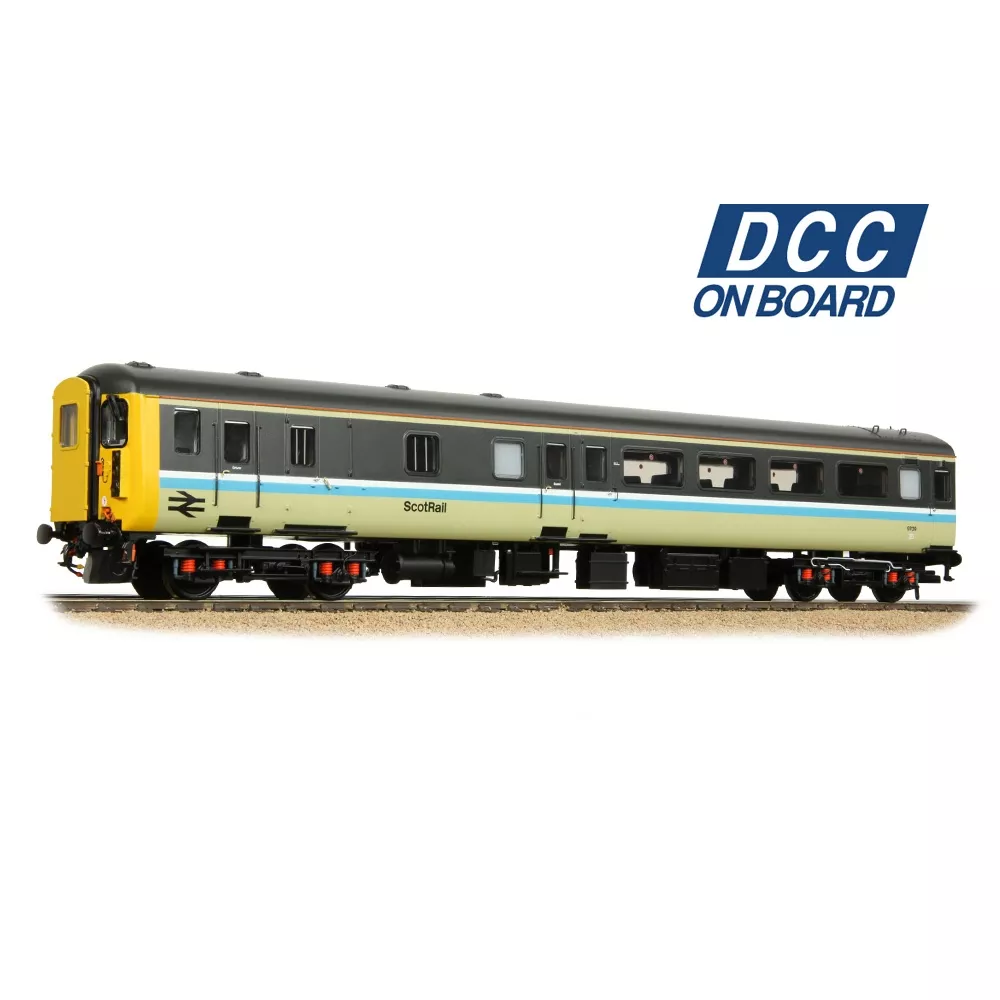
Manufacturer catalogue image - please note that pre-release images may be CAD renders or CGI/AI images rather than photographs
Prototype Era
Era 8 (1983 to 1994) British Rail Sectorisation
Manufacturer description
The Mk2Fs were the final evolution of the Mk2 family, British Rail’s second generation of standard coach design, and these coaches featured full air conditioning, interior panelling made of plastic, a new style of seating and tinted windows. Initially only three types were built, Tourist Second Opens, First Opens and Brake Second Opens, but some First Opens were later converted into Restaurant First Buffets, whilst several Brake Second Opens were fitted with a driving cab at one end, becoming Driving Brake Second Opens for push-pull use. The DBSOs were used in Scotland to work push-pull services, usually with a Class 47/7 locomotive at the other end that had been specially modified to allow push-pull operations.
When it comes to the Bachmann Branchline model, we’ve gone to great lengths to replicate every detail of the Mk2F DBSO in miniature. The Distinctive Mk2 shape is captured to a tee whilst on the roof, the ventilators are expertly moulded, and the toilet panel is completed with metal wire grab handles. The inner end features separately fitted metal handrails, the corridor gangway doors are modelled faithfully, even down to the two small windows, and the end footsteps at each corner are also included. Additional accessories are supplied which can be fitted to the inner end, including the ETH socket and cabling, along with pipework and dummy knuckle couplings.
It's the cab that makes the DBSO instantly recognisable amongst the Mk2 fleet and here, every detail has been considered, from the glazed cab windows with their separate window wiper to the corridor gangway with its optional cover. Again, a full set of bufferbeam pipework and accessories is included, along with the obstacle deflector, a characteristic feature of the DBSOs when viewed front-on. The light clusters complete the front end and working lights are fitted as standard.
On the bodysides each door is complete with hinges, handles and even door bumper details, whilst the flush, tinted glazing gives these coaches their characteristic streamlined appearance. Take a look below the solebar and you will find a full complement of equipment – all necessary for the braking, electrical and air-conditioning systems.
The bogies are fitted with metal wheelsets that run in metal bearings, with each bogie constructed from several components to ensure that the springs, suspension, brakes and, where relevant, footsteps can all be modelled in full relief along with additional details like the speedometers found on the DBSOs. The tension lock couplings fit into NEM pockets that are mounted on a close-coupling mechanism which is fitted to the coach floor, operating in tandem with the bogie as it turns. Inside each model is an interior featuring the prototypical layout of tables and chairs, guard’s compartment and luggage area, complete with the caging which enclosed it. The livery application is nothing short of exceptional, using authentic colours, logos and fonts to give every model an exquisite appearance.
The icing on the cake of this DCC On Board model is the full suite of lighting that is controlled by an integrated DCC Decoder. When used on DCC four separate lighting features can be enjoyed with individual control of the interior, Guard’s compartment and cab lights, plus the directional lights which display red or white according to the direction of travel. When used on analogue control, the interior lights and directional lights will work when power is applied.
MODEL FEATURES:
- Bachmann Branchline OO Scale
- Era 8
- Pristine BR ScotRail livery
- Running No. 9709
- Directional Lighting
- Interior Lighting
- DCC On Board – Integrated DCC Decoder provides full DCC control of the light features
- Accessory Pack
- NEM Coupling Pockets
- Close Coupling Mechanism
- Length 273mm (over couplings)
Catalogue listing
Model details
Directional lighting
Prototype information
Supplier Links


Supplier links are provided for your convenience and do not guarantee that the product is currently available. RailwayModels.uk is not a representative of these suppliers, but may receive a commission when purchases are made through links on this page.