Manufacturer catalogue image - please note that pre-release images may be CAD renders or CGI/AI images rather than photographs
Prototype Era
Era 9 (1995 to 2004) Initial Privatisation
The British Railways Mk1 was the designation given to BRās first standard design of main line coaching stock, and one of its most successful. Built from 1951 until the early 1960s to augment and replace the array of āBig Fourā and earlier āpre-groupingā designs inherited from the LMS, LNER, GWR and SR, BR took the best features from several of these types to produce the new steel-bodied design. As a result, the Mk1 was stronger and safer than any of the inherited types that came before it.
Supplier links are provided for your convenience and do not guarantee that the product is currently available. RailwayModels.uk is not a representative of these suppliers, but may receive a commission when purchases are made through links on this page.
£69.95 at eBay (New)
Bachmann 39-059APF BR Mk1 TSO Tourist Second Open WCRC Maroon [PF] OO Gauge
£0.00 at Amazon
Bachmann 39-059APF BR Mk1 TSO Tourist Second Open WCRC Maroon [PF] OO Gauge
Online offers are generated automatically based on brand name and product code, and may not necessarily be this precise item.
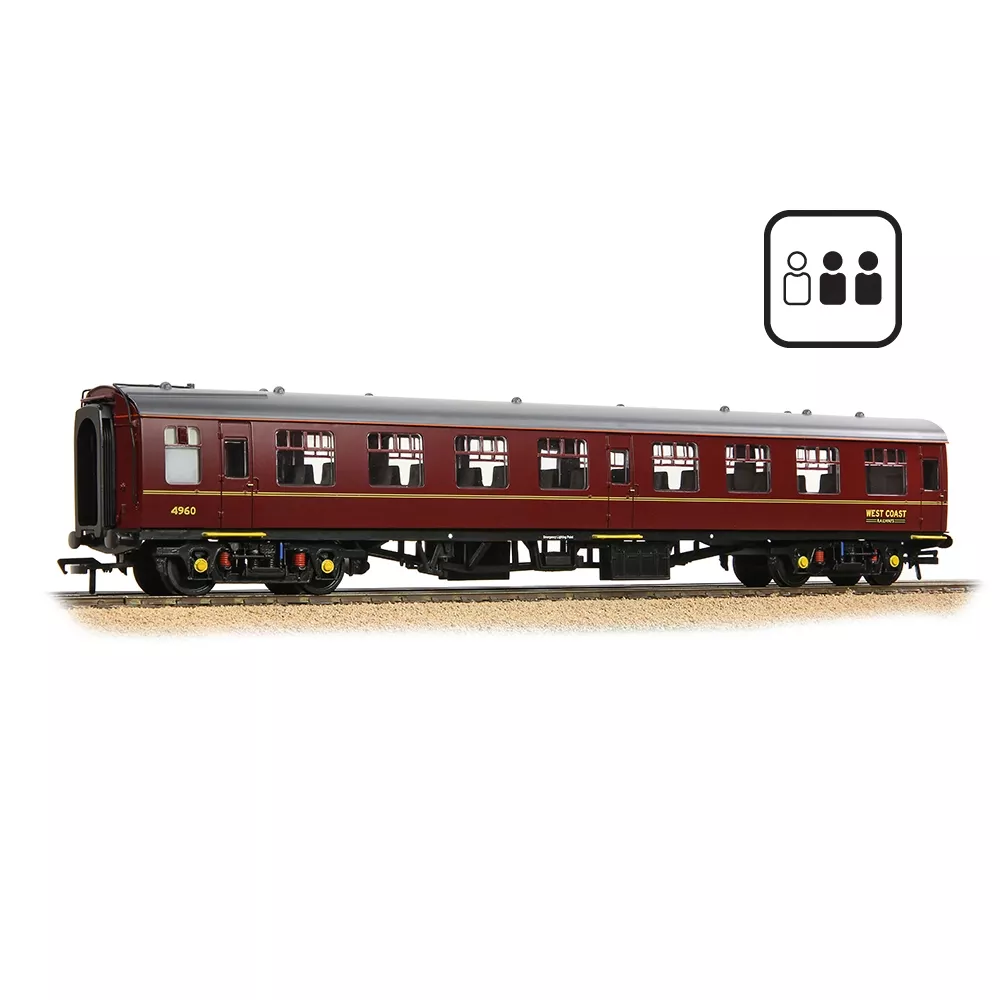
Bachmann BR Mk1 TSO Tourist Second Open (WCRC) ā Maroon, 4960. The model is finished in pristine condition and painted in a maroon livery. It measures 270āÆmm in length, uses an NEM coupling and includes passenger figures. The coach is a British Railways MarkāÆ1, classified as a Tourist Standard Open (TSO), and carries the running number 4960.
It is marketed as a West Coast Railways (WCRC) unit and carries the manufacturer part number 39ā059APF. The model represents the period of the initial privatisation of British Rail, which began in the midā1990s.
The British Railways Mk1 was BRās first standard design of maināline coaching stock, produced from 1951 until the early 1960s. It replaced the preāgrouping and āBig Fourā designs inherited from the LMS, LNER, GWR and SR, combining the best features of those types into a stronger, steelābodied carriage that was considered safer and more robust than its predecessors.