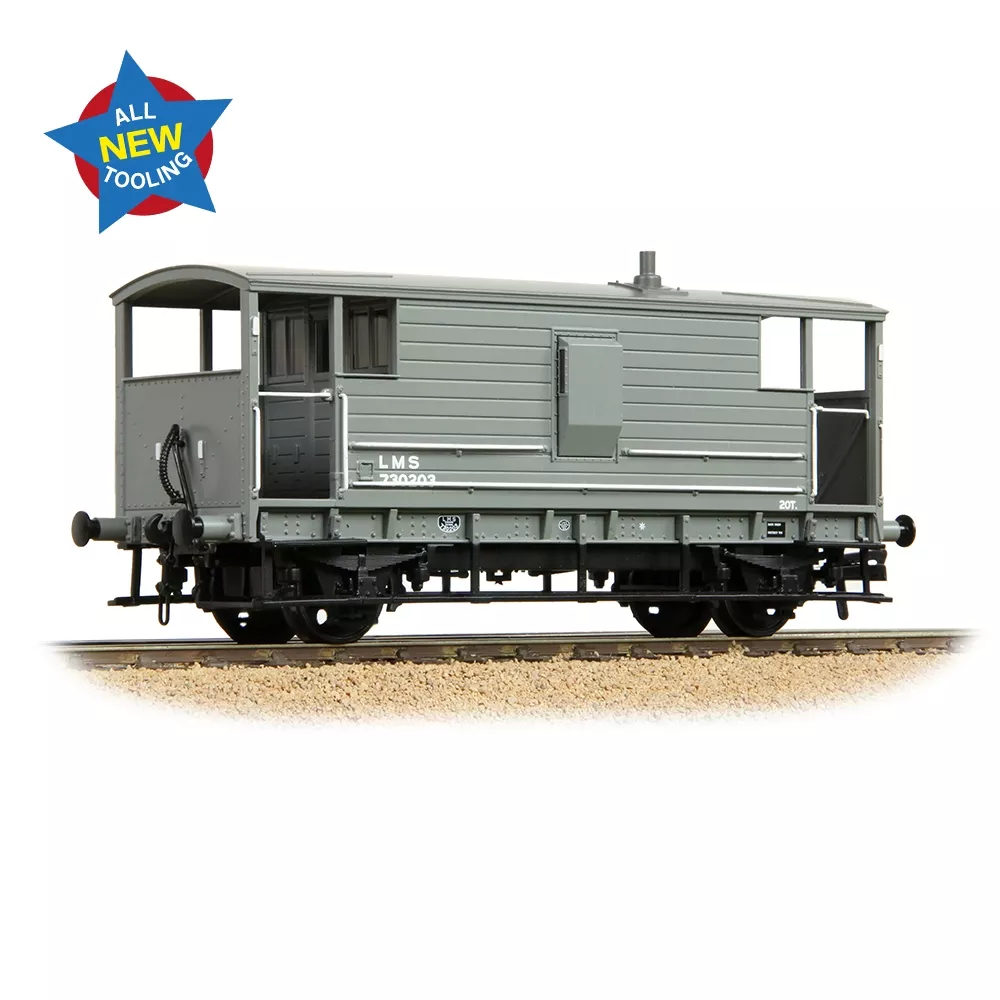
Manufacturer catalogue image - please note that pre-release images may be CAD renders or CGI/AI images rather than photographs
Prototype Era
Era 3 (1923 to 1947) The Big Four (LNER, LMS, GWR and SR)
Manufacturer description
This new Bachmann Branchline model of the LMS Standard 20 Ton Brake Van sets a new standard for these iconic vehicles, of which 2,774 examples were built between 1935 and 1950, first by the London, Midland and Scottish Railway (LMS) and then by British Railways (BR) who recognised the merits of the LMS design.
With an extensive tooling suite catering for many of the variations that were incorporated into the real vans during their construction and subsequent use, authentic models can be produced of brake vans in their early years when first entering traffic in the 1930s, to their final days in departmental use at the end of the twentieth century.
Boasting a wealth of detail, from the separately fitted metal handrails to the individual brake components and cabin interior, the new Branchline models are fitted with blackened metal wheelsets and NEM coupling pockets, providing smooth running and operational versatility alongside their good looks. The icing on the cake is the livery application, with rich paintwork and authentic numbering and markings, completing this valuable addition to the extensive range of Branchline goods rolling stock.
Read more about the Bachmann Branchline LMS 20T Brake Vans
MODEL FEATURES:
- Bachmann Branchline OO Scale
- Era 3
- Pristine LMS Grey (LMS) livery
- Running No. 730203
- Model depicts a Diagram D1919 van with:
- Through Vacuum Pipes
- Shallow Guard Duckets
- Narrow Ducket Beading
- Rivetted End Panels
- Extended Buffers
- Shallow Ballast Weights
- Accessory Pack
- NEM Coupling Pockets
- Length 118mm (over couplings)
Catalogue listing
Model details
Prototype information
Supplier Links


Supplier links are provided for your convenience and do not guarantee that the product is currently available. RailwayModels.uk is not a representative of these suppliers, but may receive a commission when purchases are made through links on this page.