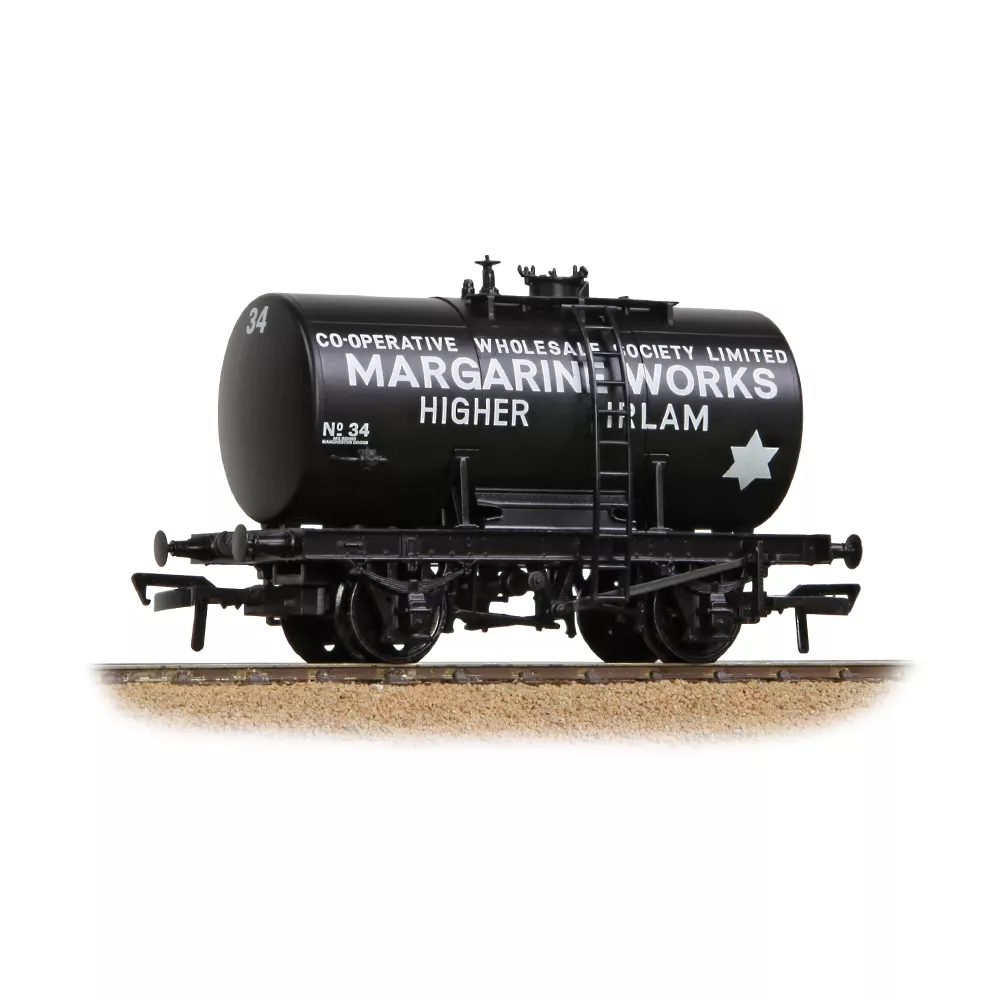
Manufacturer catalogue image - please note that pre-release images may be CAD renders or CGI images rather than photographs
Prototype Era
Era 3 (1923 to 1947) The Big Four (LNER, LMS, GWR and SR)
Manufacturer description
Early 14 Ton Tank Wagons with timber saddles, cradles and wire hawsers were built in response to the need for oil products to fuel Britain’s rapid development during the early-twentieth century, along with two world wars. As the hostilities of World War Two drew to a close, a new design of tank with a central anchor mechanism securing the tank to the chassis was agreed between the private operators, the Petroleum Board and the railway companies. Construction of this new wagon did not pick up pace until the early-1950s, and with the introduction of larger, vacuum braked tank wagons during the late-1950s, the Anchor-Mount design soon became obsolete, and the final wagons of this type were built in 1963.
The Bachmann Branchline model covers both the Class A and Class B tanks and can be produced with several variations. As standard, each model features separately fitted brake gear and brake levers, along with the filler cap which includes the distinctive securing clamps. On the prototype the underframe was constructed from metal section, and this is replicated on the model affording an unobstructed view through the frames when observed from above.
MODEL FEATURES:
- Bachmann Branchline OO Scale
- Era 3
- Pristine ‘Irlam Margarine Works’ Black livery
- Running No. 34
- Spoked Wheels
- NEM Coupling Pockets
- Length 105mm
Catalogue listing
Model details
Prototype information
Supplier Links


Supplier links are provided for your convenience and do not guarantee that the product is currently available. RailwayModels.uk is not a representative of these suppliers, but may receive a commission when purchases are made through links on this page.