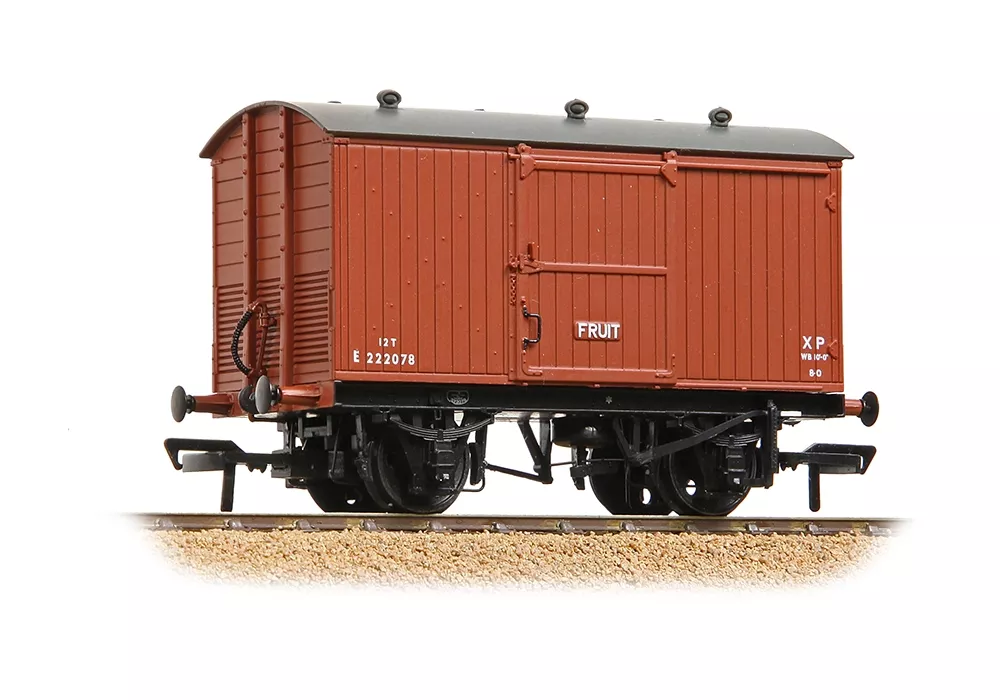
Manufacturer catalogue image - please note that pre-release images may be CAD renders or CGI/AI images rather than photographs
Prototype Era
Era 4 (1948 to 1956) British Railways Early Crest
Manufacturer description
Britain’s railways were developed primarily to move freight and the early railway companies employed vans of many different designs to transport goods and merchandise that required covered transport. Each railway company had its own designs, some of which were intended for specific traffic like this Fruit Van built by the London and North Eastern Railway (LNER). The fruit vans sported louvres at each end and ventilators on the roof to allow fresh air to circulate within, keeping fruit fresh during its journey.
This Branchline models depicts one of those wooden bodied vans and the planked body is replicated with fine engraving, with precision moulding to capture every detail of the sliding doors and their mechanism, topped off with a separately fitted metal door handle. On the roof, the six ventilators are each moulded in full relief before being added individually, the central pair being offset as per the prototype.
The chassis employs metal wheelsets of the 3-hole disc variety around which safety loops are added from formed metal wire, whilst the brakes, brake handles and associated gear is all included. Representing a van fitted with vacuum brakes, the brake cylinder is mounted underneath the wagon and brake pipes are fitted to each bufferbeam alongside metal buffer heads cosmetic coupling hooks.
MODEL FEATURES:
- Bachmann Branchline OO Scale
- Era 4
- Pristine BR Bauxite (Early) livery
- Running No. E222078
- NEM Coupling Pockets
- Length 90mm (over couplings)
Catalogue listing
Model details
Prototype information
Supplier Links


Supplier links are provided for your convenience and do not guarantee that the product is currently available. RailwayModels.uk is not a representative of these suppliers, but may receive a commission when purchases are made through links on this page.