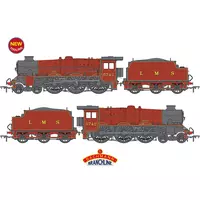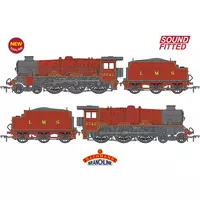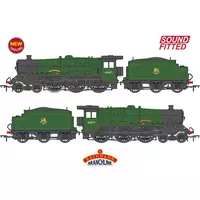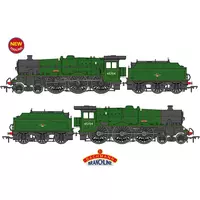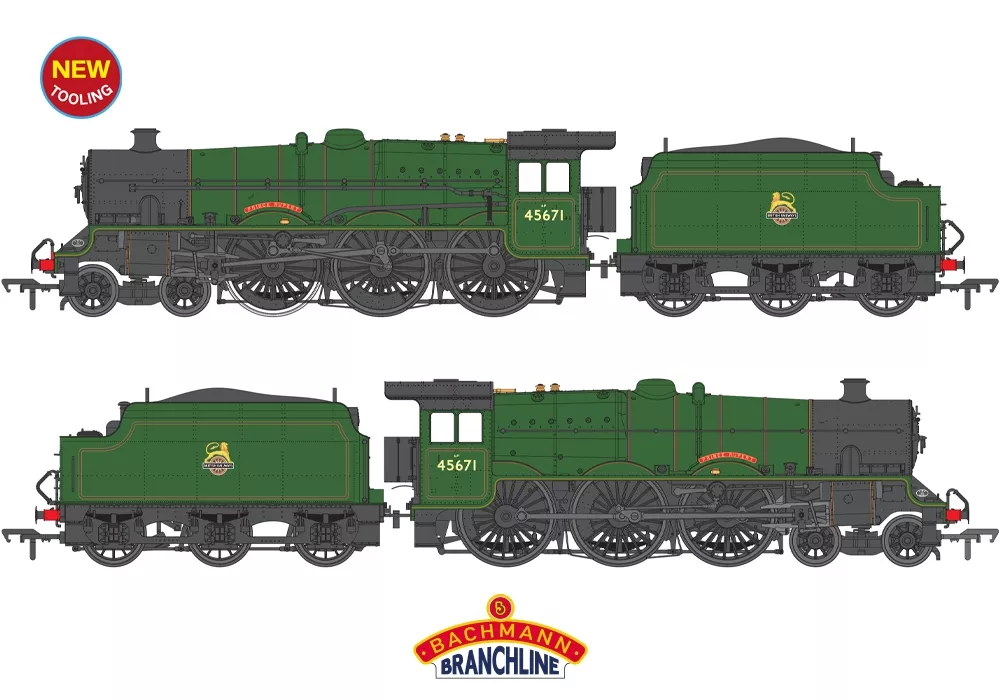
Manufacturer catalogue image - please note that pre-release images may be CAD renders or CGI images rather than photographs
Prototype Era
Era 4 (1948 to 1956) British Railways Early Crest
Manufacturer description
The LMS Jubilee Class locomotive has long been a popular model in the Bachmann Branchline steam portfolio and for 2026 the Jubilee returns, better than ever before and with new tooling to allow models of the later-built locomotives to be offered to modern standards for the first time.
The LMS built 191 Jubilees during a 3-year period and after the first 113 were completed, changes were made to the design of the boiler resulting in the final 78 examples boasting a larger firebox created using a sloping firebox throatplate. New tooling for the Branchline Jubilee means that No. 45671 ‘Prince Rupert’ can now be modelled in full BR glory.
Constructed around a diecast metal running plate, the Branchline Jubilee employs precision moulded components like the boiler, firebox and cab which are then adorned with countless separate detailing parts like the metal handrails, turned brass safety valves and whistle, lamp irons, lubricators and sandboxes. With authentic pattern driving wheels and a detailed front bogie, the chassis is further enhanced with brake blocks, brake rigging and sandboxes with separate wire sandpipes.
The locomotive is coupled to a riveted Stanier tender using an adjustable drawbar to suit individual layout conditions, whilst electrical connections are incorporated into the drawbar and a poseable fallplate is fitted to the tender. Combining a finely detailed body and chassis, the tender is completed with sperate metal handrails, water pick-up gear, tank vents and lamp irons. A realistic coal load is included which is removable, beneath it the empty coal space is modelled too. Sprung metal buffers are fitted to both the front of the locomotive and the rear of the tender.
Within the cab, a detailed boiler backhead is present and the pipework and controls are enhanced with individual decoration. The ventilator on the cab roof is a separate part, allowing it to be posed in the open or closed position, or somewhere in between. The high level of decoration is not reserved only for the cab interior of course, and the model boasts an authentic rendition of the iconic BR lined Green livery complete with full-colour BR emblems. The name is carried on the splasher and etched nameplates are supplied for user-fitting to complete the look of this express locomotive.
With a powerful three pole motor and a proven drive train, the Branchline Jubilee is surefooted machine that boasts electrical pickups from the driving wheels and tender wheels. Upgraded to include a firebox lighting system that works on both analogue and DCC, the DCC provision has also been enhanced and a Plux22 DCC decoder socket is now fitted in the tender along with a pre-fitted speaker making it easy to add sound, or why not opt for our SOUND FITTED model and the work’s done for you.
- Bachmann Branchline OO Scale
- Era 4
- Pristine BR Lined Green Early Emblem livery
- Running No. 45671
- Named ‘Prince Rupert’
- Etched Nameplates included
- Equipped with a Plux22 DCC Decoder Socket – Recommend Decoder item No. 36-570A
- Length 261mm (over couplings)
DETAIL VARIATIONS SPECIFIC TO THIS MODEL
- Long Firebox
- Single Chimney
- Riveted Stanier 4,000-gallon Tender
- Smokebox Door with Large Numberplate
BACHMANN BRANCHLINE LMS JUBILEE SPECIFICATION
MECHANISM:
- Three pole motor mounted in the locomotive, driving the central set of driving wheels
- Electrical pickup from all driving wheels along with tender pickups
- Diecast metal chassis block (locomotive)
- Gearing arranged for prototypical running speeds and haulage capabilities
- 16.5mm (OO gauge) wheels to NEM310 & NEM311 standards with authentic profile and detailing
- Valve gear of metal construction
- Adjustable tender drawbar with integral loco-tender wiring
- Sprung front bogie with integral coupling pocket to NEM362 standards
- Detachable coupling pocket to NEM362 standards fitted to the tender
- Designed to operate on curves of second radius (438mm) or greater
DETAILING:
- Diecast metal running plate
- Precision moulded boiler & firebox, cab, tender tank and tender chassis
- Separately fitted smokebox door which is mounted on hinges and can be posed open or closed
- Separately applied details including chimney, smokebox saddle, splashers, sandboxes, lubricators, water pick-up gear, reverser, lamp irons and smokebox door handles
- Individual metal detail components including handrails, handrail knobs, whistle, safety valves, sandpipes and tender vents
- Highly detailed and decorated cab interior including controls, dials, gauges and tool cabinets with separately fitted valve wheels, regulator and reverser
- Hinged and posable metal fall plate between the locomotive and tender
- Sliding cab roof ventilator which can be posed open or closed
- Tender fitted with removable coal-effect load, with empty coal space modelled beneath
- Running gear detailing includes brakes and separately fitted brake gear on the locomotive and tender
- Glazed cab windows
- Sprung metal buffers
- Each model supplied with an accessory pack including cab doors, front steps and cylinder draincocks
LIGHTING:
- Firebox Glow (on analogue) / Firebox Glow & Flicker (on DCC or when SOUND FITTED models are used on analogue)
DCC:
- Plux22 DCC decoder interface located in the tender
SOUND:
- Speaker installed in the tender of all models for optimum sound reproduction
- Zimo MS450P22 DCC Sound Decoder pre-installed in SOUND FITTED versions
- Sound files produced specifically for the Bachmann Branchline Jubilee using recordings from real locomotives
- SOUND FITTED models operate on DCC and Analogue control as supplied
LIVERY APPLICATION:
- Authentic liveries applied to all models
- Multiple paint applications employed on each model
- Logos, numerals and text added as appropriate using multi-stage tampo printing process, incorporating authentic typefaces, logos and colours
- Pre-fitted printed nameplates, as well as etched nameplates which are supplied separately for optional fitting
LMS JUBILEE HISTORY
The ‘Jubilee’ 4-6-0 locomotives were introduced between 1934 and 1936 by the London, Midland & Scottish Railway (LMS) to the design of William Stanier. The type was a direct follow on to Henry Fowler’s Patriot Class, the final five of which became the first Jubilees when they were built with Stanier’s tapered boiler and top feeds in place of the parallel boilers used on the Patriots.
The Class totalled 191 examples, and the first 113 rolled off the production line before a brief pause. When construction commenced again, changes had been made to the boilers which on the final 78 examples employed a sloping firebox throatplate, increasing the size of the firebox over the first 113 that had straight throatplates.
In 1935 the class was chosen to commemorate the Silver Jubilee of King George V and No. 5552 (which swapped its number with 5642) was named ‘Silver Jubilee’, resulting in the type taking the class name the Jubilees. Other locomotives in the fleet were named after the British Empire and the Commonwealth, British naval commanders and admirals, and notable Royal Navy ships. All 191 examples carried a name.
The Jubilees were intended for express passenger workings and were employed on the LMS’s main line routes. At first, their performance was underwhelming as they suffered from poor steaming, but through a series of trialling different blast pipe arrangements, chimney dimensions, and even the use of the double chimney, their steaming ability greatly improved.
Coupled to tenders built to both Fowler and Stanier designs, in later years some Jubilees swapped their tenders with 8Fs, exchanging their Fowler tenders for Stanier types which boasted a greater water carrying capacity.
In 1942 the LMS rebuilt two Jubilees with new boilers providing upgrades in the power and steaming abilities compared to the standard locomotives, however the increased weight resulting from the changes restricted their route availability and no further Jubilees were rebuilt.
The entire fleet passed into British Railways ownership in 1948 and remained intact until 1960, except for one example that was withdrawn in 1952 following collision damage. Another was retired in 1960 before withdrawals accelerated, peaking in 1964 although there were still eight examples in traffic in 1967, but all had stopped by the end of that year.
Thankfully four Jubilees have been preserved including examples from both the first 113 locomotives with their short fireboxes, and the final 78 with longer versions. This includes No. 45596 which is unique amongst the four in being fitted with a double chimney.
Catalogue listing
Model details
Prototype information
* Class names often change over the lifespan of a locomotive, so this is not necessarily the class name used by the operator in the period modelled.
Supplier Links


Supplier links are provided for your convenience and do not guarantee that the product is currently available. RailwayModels.uk is not a representative of these suppliers, but may receive a commission when purchases are made through links on this page.