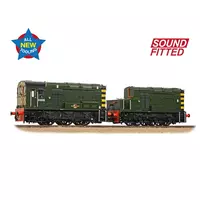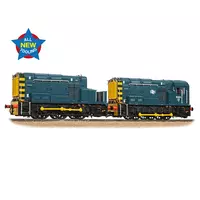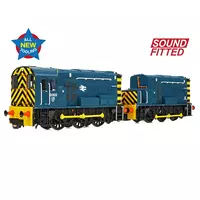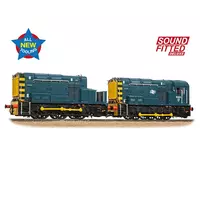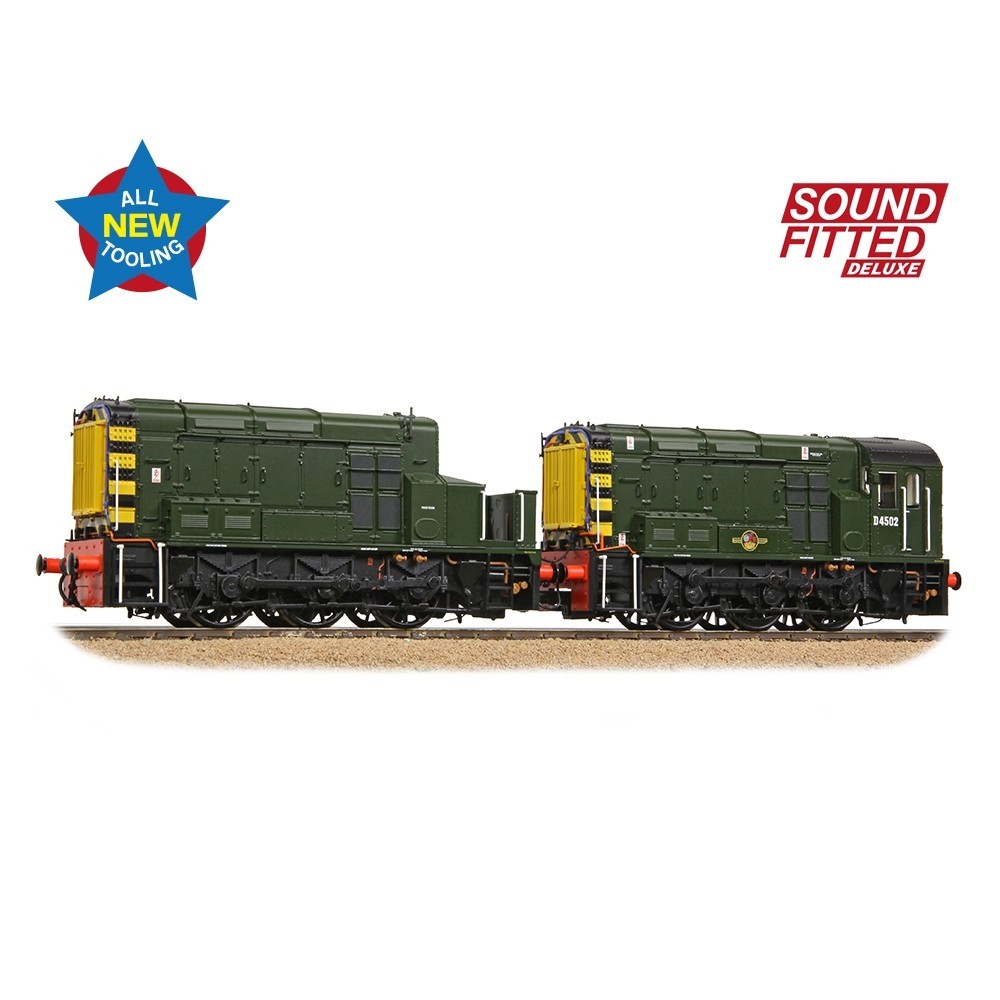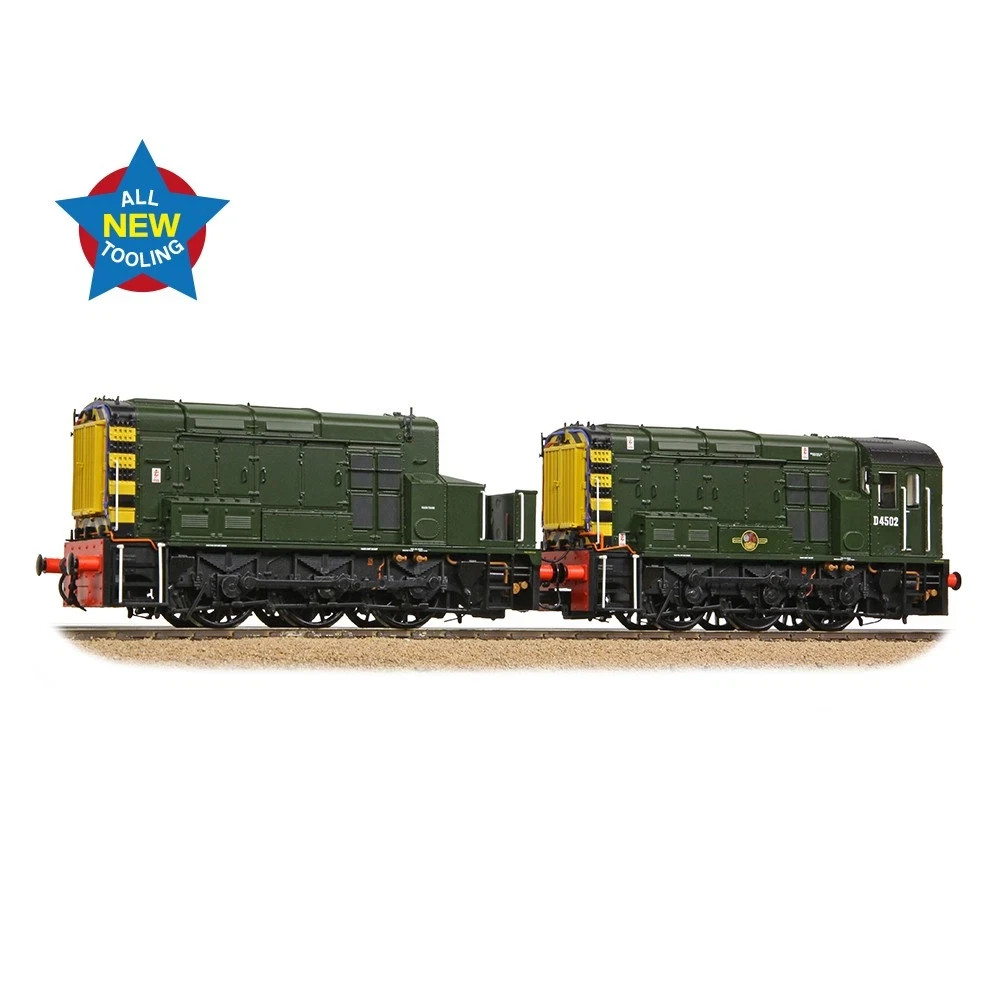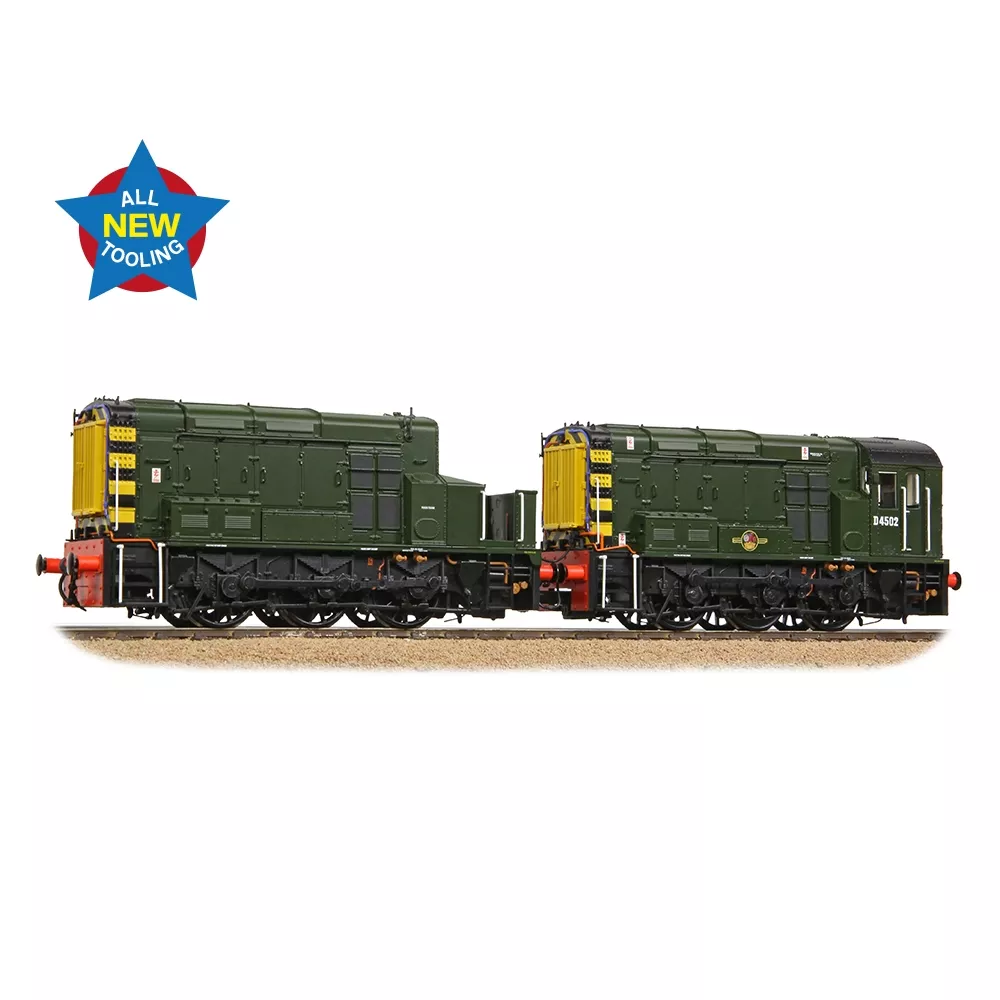
Manufacturer catalogue image - please note that pre-release images may be CAD renders or CGI/AI images rather than photographs
Prototype Era
Era 6 (1967 to 1972) British Rail Blue (Pre-TOPS)
Manufacturer description
The Class 13 Diesel Shunter is one of the few classes of diesel locomotive never to have been modelled in OO scale, until now! After mastering the Class 08, Bachmann Branchline has been slaving away on models of these enigmatic locomotives which were created from two Class 08s to shunt the Tinsley Marshalling Yard near Sheffield, South Yorkshire, between 1965 and 1985.
The new Branchline model shares a lot of its DNA with its Class 08 cousins, employing the same high mechanical and technical specification for smooth and powerful running, and with advanced electrical features like the Bach-Up Stay Alive system providing DCC users with uninterrupted power and the full suite of lighting which is user-configurable whether you’re running on analogue or DCC. What’s more, both the master and slave units are motorised and fully functional, meaning you’re effectively getting two locomotives in one!
Externally, new tooling has been produced to capture all the hallmarks of the master and slave units that made up the Class 13, from the heavy-duty bufferbeams that were thickened and enlarged to add weight and aid adhesion on the real locos to the drastic changes made to the slave unit with the removal of much of its cab and controls. This external beauty is brought to life by the exquisite livery application which uses true-to-prototype colours, fonts and logos to create the ultimate diesel shunter.
- Bachmann Branchline OO Scale
- Era 6
- Pristine BR Green (Wasp Stripes) livery
- Running No. D4502
- LMS Pattern Buffers
- Equipped with two Plux22 DCC Decoder Sockets – recommended Decoder item No. 36-570A (x2)
- Length 244mm
BACHMANN BRANCHLINE CLASS 13 SPECIFICATION
EACH CLASS 13 COMPRISES 1x MASTER UNIT AND 1x SLAVE UNIT, BOTH OF WHICH ARE MOTORISED AND FULLY FUNCTIONAL
MECHANISM (COMMON FEATURES FOUND ON BOTH THE MASTER AND SLAVE UNIT):
- Five pole motor with flywheel providing drive to the rear axle
- Sprung centre axle to aid running over uneven track
- Electrical pickup from all wheels
- Separate metal bearings fitted to each axle
- Diecast metal chassis block incorporating the gearbox, with gearing arranged for prototypical running speeds and haulage capabilities
- 16.5mm (OO gauge) wheels to NEM310 & NEM311 standards with authentic profile and detailing
- Detachable coupling pockets to NEM362 standards fitted at the cab end of the Master unit and the radiator end of the Slave unit
- Master and Slave units connect with a rigid coupling bar that fits into NEM362 coupling pockets mounted to integral close coupling mechanisms
- Auto-Release Couplings fitted at the cab end of the master unit and the radiator end of the slave unit – DCC operated, hands-free uncoupling with the press of a function button (SOUND FITTED DELUXE models only)
- Designed to operate on curves of second radius (438mm) or greater
DETAILING (COMMON FEATURES FOUND ON BOTH THE MASTER AND SLAVE UNIT, WHERE APPLICABLE):
- Precision moulded bodyshell and frames/running board with numerous separately fitted parts including footsteps, bonnet grilles and lamp irons
- Separately applied metal detail parts, including sand boxes and sand pipes, grab handles, windscreen wipers, light conduits and lifting points
- Authentic outside-framed running gear
- Frames constructed from multiple components, including separate springs and brake gear allowing full relief detailing
- Sprung metal buffers
- Cab interior detailing which includes the control desk, instruments & dials, equipment cabinets and handbrake, all with era-specific decoration
- Each model supplied with a full set of decorated bufferbeam pipework, master-to-slave pipes and cables, bufferbeam infills and accessory parts including screw-link couplings (cosmetic)
LIGHTING – MASTER UNIT:
- Four fully operational marker lights on the cab end, controlled by microswitches (easily accessed via the removable, clip-on roof panel) allowing user-configured light patterns and colours* (*selected lights only, choose between red or white)
- Shunting lights (one red and one white light) operated via a dedicated function on DCC (one DCC function controls the shunting lights on both the Master and Slave unit), or using an easy access microswitch on Analogue control
- Cab light operated via a dedicated function on DCC, or using an easy access microswitch on Analogue control
- All marker lights on the Master unit can be turned on/off independent of the Slave unit via two dedicated functions on DCC, or using an easy access microswitch on Analogue control
- Authentic light colours and temperatures selected for each model based on era and application
- Lights fitted to the radiator end are prototypically non-functional
LIGHTING – SLAVE UNIT:
- Four fully operational marker lights on the radiator end, controlled by microswitches (easily accessed via the removable, clip-on roof panel) allowing user-configured light patterns and colours* (*selected lights only, choose between red or white)
- Shunting lights (one red and one white light) operated via a dedicated function on DCC (one DCC function controls the shunting lights on both the Slave and Master unit), or using an easy access microswitch on Analogue control
- All marker lights on the Slave unit can be turned on/off independent of the Master unit via two dedicated functions on DCC, or using an easy access microswitch on Analogue control
- Authentic light colours and temperatures selected for each model based on era and application
DCC (COMMON FEATURES FOUND ON BOTH THE MASTER AND SLAVE UNIT):
- Plux22 DCC decoder interface
- Easy-access DCC decoder socket via a removable roof panel – secured by clips for ensured fit and alignment
- 2-pin connector wire for use between the Master and Slave units to ensure full DCC-functionality
- Bach-Up Stay Alive System providing uninterrupted power to prevent stalling, light flicker and sound cut-outs (operates on DCC only)
SOUND:
- Two quality speakers employed for optimum sound reproduction, one in the Master unit and one in the Slave unit, fitted to every model as standard
- SOUND FITTED and SOUND FITTED DELUXE versions come with a pre-installed Zimo MS450P22 DCC Sound Decoder in the Master unit and a Zimo MN330P22 Loco Decoder in the Slave Unit
- Sound files produced specifically for the Bachmann Branchline Class 13 using recordings from real locomotives
- SOUND FITTED and SOUND FITTED DELUXE models operate on DCC and Analogue control as supplied. On Analogue, an authentic engine start up sequence and running sounds are produced when power is applied
LIVERY APPLICATION:
- Authentic liveries applied to all models
- Multiple paint applications employed on each model using BR specification colours
- Logos, numerals and text added as appropriate using multi-stage tampo printing process, incorporating authentic typefaces, logos and colours
CLASS 13 HISTORY
Although diesel shunters had been trialled by the ‘Big Four’ railway companies as early as the 1930s, it was not until after Nationalisation in 1948 that their use became widespread, culminating in the creation of the British Railways (BR) 350hp diesel electric shunter – or Class 08. Eventually 996 locomotives were built, making the Class 08 the most numerous of all British locomotive classes.
The 08s proved to be strong and versatile machines, capable of most shunting tasks, but there were some unique scenarios where they were not quite up to the job. One such scenario was at Tinsley Marshalling Yard, to the northeast of Sheffield; an enormous freight marshalling yard which opened in 1965 and was essentially a distribution hub where goods trains would arrive, be broken down, and were then reformed for onwards travel to other destinations. To aid the forming of new trains the yard employed hump shunting which allowed wagons to roll into the siding where their train was being assembled, however, to move these trains and propel the wagons up the hump for gravity to take effect, a new locomotive was required.
The solution was the Class 13. Formed of two modified Class 08s, the 13s had a greater tractive effort than any standard locomotive in BR’s fleet at the time, and by using two locomotives coupled together rather than one long-framed bogie locomotive, the risk of grounding on the hump was avoided.
The Class 13s were built at BR’s Darlington Works in 1965, using six standard Class 08s to create three new locomotives each comprising a Master Unit and a Slave Unit. The donor locomotives were fitted with heavy metal plates to their bufferbeams to improve adhesion, visually this resulted in the bufferbeams being both thicker and much deeper. Multi-working equipment was fitted to the two units as well, allowing both locos to be controlled from the master and enabling the cab of the slave unit to be removed. Special in-cab signalling and radio equipment was installed to allow communications with the control tower that presided over shunting operations at Tinsley.
The three Class 13s were delivered in BR Green livery with wasp stripes at the outer ends and were initially formed cab-to-cab, but within a couple of years they had been reformed with the slave leading the master, both radiator first, to improve crew visibility. As a result, the master unit ended up with wasp stripes at each end, meanwhile the shortened former cab sheet of the slave remained plain at first, however wasp stripes were eventually added here too.
Even as Tinsley Yard was opened by Dr Richard Beeching in 1965, British Rail was already feeling a hit on its services from the increasing competition provided by road transport and this only worsened in the 1970s as the decline in wagon-load goods traffic continued. By the 1980s the writing was on the wall for large marshalling yards like Tinsley and in December 1984, the arrival sidings and hump were closed, making the Class 13s redundant and leading to their withdrawal at the start of 1985. By this time only Nos. 13001 and 13003 (originally Nos. D4501 and D4500) remained in traffic anyway, as No. 13002 (D4502) had been taken out of service in mid-1981.
Whilst the Class 13s were destined for a life working at Tinsley Yard, each of the three locomotives was dispatched to Doncaster Works for a major works overhaul once during their careers, and on occasion in their twilight years, it was not impossible to find a Class 13 heading a railtour in the local area. Following withdrawal, Nos. 13001 and 13002 would make their way to Swindon for disposal, while No. 13003 went back to Doncaster to be scrapped, finally succumbing to the cutter’s torch in September 1986, more than 18 months after it last worked at Tinsley.
Catalogue listing
Model details
Directional lighting
Prototype information
* Class names often change over the lifespan of a locomotive, so this is not necessarily the class name used by the operator in the period modelled.
Supplier Links


Supplier links are provided for your convenience and do not guarantee that the product is currently available. RailwayModels.uk is not a representative of these suppliers, but may receive a commission when purchases are made through links on this page.