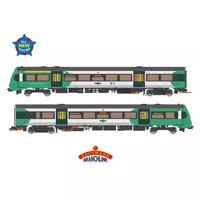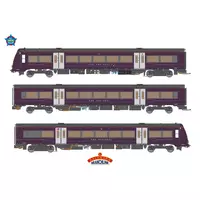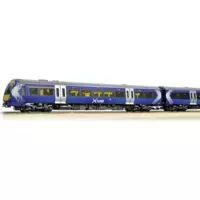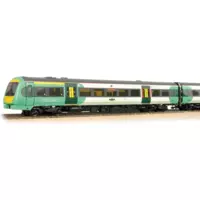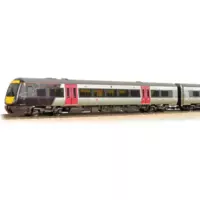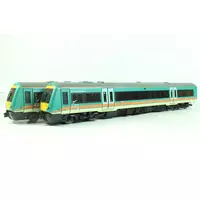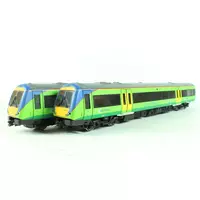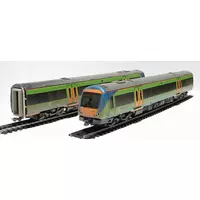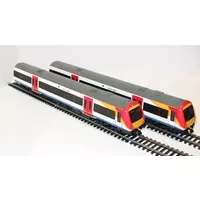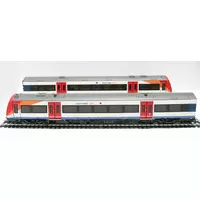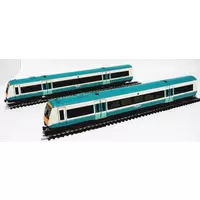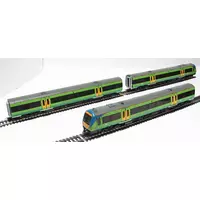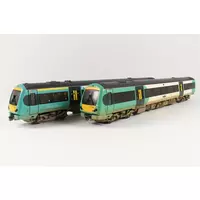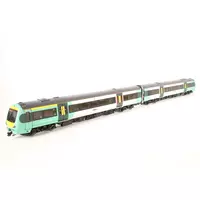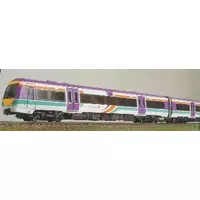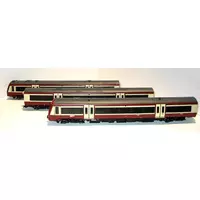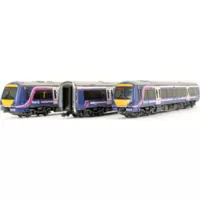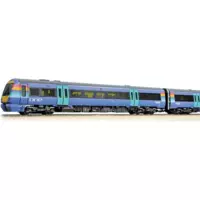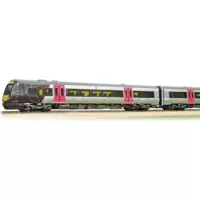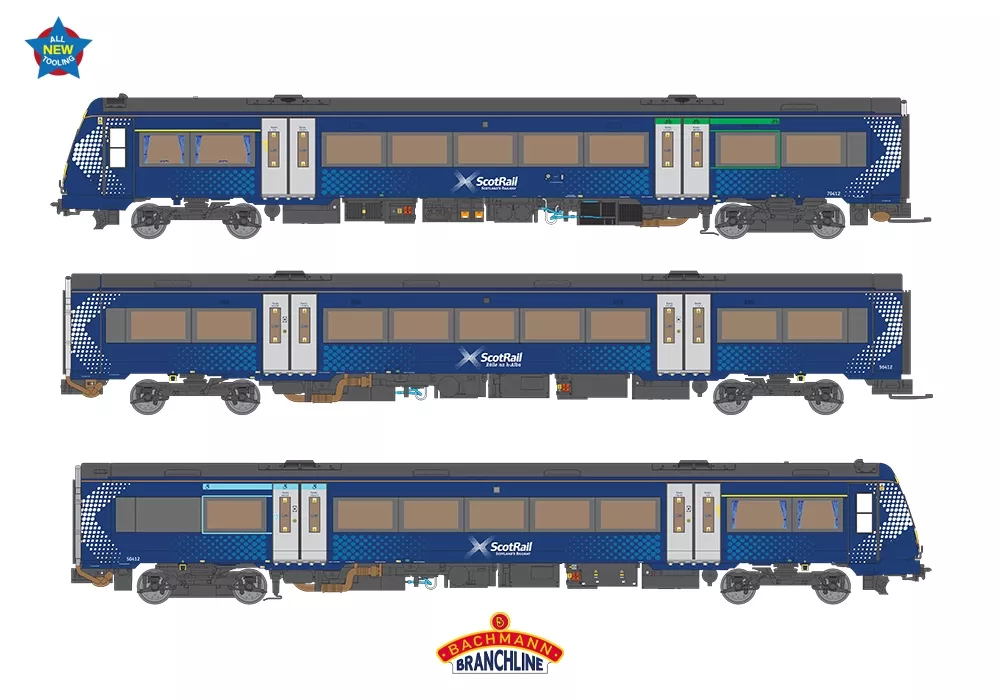
Manufacturer catalogue image - please note that pre-release images may be CAD renders or CGI/AI images rather than photographs
Prototype Eras
Era 9 (1995 to 2004) Initial Privatisation
Era 10 (2005 to 2015) Rebuilding of the Railways
Era 11 (2016 to 2026) The Last Days of Privatisation
Manufacturer description
The Branchline ‘Turbostar’ is back with this brand-new model that has been designed from the rails up to create a new star for the OO scale multiple unit fleet. Building on the success of the Branchline Class 158 with its low level, invisible drive train and comprehensive lighting suite, our new ‘Turbostar’ take things a step further with the addition of a Bach-Up Stay Alive System. Like the 158, a Plux22 DCC Decoder socket is located beneath a removable underframe panel and this controls all vehicles via the inter-car couplings which incorporate close-coupling mechanisms and multiway electrical connections.
The lighting features include directional lights with day/night modes and independent control of either end, a necessity when you’re working your units in multiple, which you can do thanks to the working miniature BSI couplings fitted to the outer ends, allowing the new 170 to couple in multiple or with other units like the Branchline 158s. Passenger saloon lighting is fitted as are illuminated destination panels, while DCC users can take advantage of the working door interlock lights, and cab lights too.
The model’s impressive specification is complemented by its good looks which are brought to life with the exquisite livery application, using authentic colours, logos and markings to create a showpiece model worthy of any modern collection.
MODEL FEATURES:
- Bachmann Branchline OO Scale
- Era 9
- Pristine ScotRail livery
- Running No. 170412
- Three-Car Unit comprising car Nos. 50412, 56412 & 79412
- Destination blinds for Edinburgh Waverley
- Equipped with a Plux22 DCC Decoder Socket – recommended Decoder item No. 36-570A
- Length 922mm
BACHMANN BRANCHLINE ‘TURBOSTAR’ SPECIFCIATION
MECHANISM:
EACH THREE-CAR UNIT COMPRISES TWO POWERED DRIVING VEHICLES AND ONE UNPOWERED TRAILER VEHICLE WITH THE FOLLOWING FEATURES:
- Three pole motor with flywheel providing drive to the inner bogie (Driving Vehicles Only)
- Twin axle drive (Driving Vehicles Only)
- Separate metal bearings fitted to each driven axle (Driving Vehicles Only)
- Trailing axles run in metal pinpoint bearings
- Electrical pickup from all wheels
- Diecast metal, multi-stage gearbox, with gearing arranged for prototypical running speeds and haulage capabilities (Driving Vehicles Only)
- 16.5mm (OO gauge) wheels to NEM310 & NEM311 standards with authentic profile and detailing
- Working miniature BSI or Dellner Couplings (depending on variant) at the cab end (Driving Vehicles Only)
- Conductive couplings with integral close coupling mechanism at gangway ends
- Designed to operate on curves of second radius (438mm) or greater
DETAILING:
- Precision moulded bodyshells with accurately engraved details such as panel lines, doors and vents
- Prototypical ‘Ribbon’ glazing on each side with separate flush glazing for the doors and windscreens
- Separately applied etched metal roof grilles and windscreen wipers
- Authentic Bogie mouldings complete with brake and suspension detail
- Fully detailed underframes comprising numerous separately fitted, high fidelity components
- Passenger saloon interior complete with tables, chairs and partition walling
- Driver’s cab includes the control desk, seat and cab rear bulkhead with authentic detailing
- Each model is supplied with an accessory pack and coupling tool
LIGHTING:
- Directional lighting with Day/Night mode – selectable via the chassis-mounted switches or via a dedicated DCC function
- Directional lights can be turned on/off at each end independently via the chassis-mounted switches or via separate DCC functions
- Illuminated destination panels, including central bodyside panels where applicable
- Passenger saloon lighting – switchable on/off via the chassis-mounted switches or via a dedicated DCC function
- Cab lighting at the trailing end*
- Door interlock lights* (*when used on DCC)
- Authentic light colours and temperatures selected for each lighting application
DCC:
- Plux22 DCC decoder interface – one decoder required per unit
- Easy-access DCC decoder socket located behind removable panel on underside of the master driving car
- Bach-Up Stay Alive System providing uninterrupted power to prevent stalling, light flicker and sound cut-outs (operates on DCC only)
SOUND:
- Two speakers fitted, one in each driving vehicle, for optimum sound reproduction – fitted to every model as standard
- ESU Loksound V5DCC Sound Decoder pre-installed in SOUND FITTED versions
- Sound files produced specifically for the Bachmann Branchline Class 170/171 DMU using recordings from real units
- SOUND FITTED models operate on DCC and Analogue control as supplied
LIVERY APPLICATION:
- Authentic liveries applied to each vehicle including interior decoration
- Multiple paint applications employed using corporate specification colours
- Logos, numerals and text added as appropriate using multi-stage tampo printing process, incorporating authentic typefaces, logos and colours
CLASS 168/170/171 ‘TURBOSTAR’ DMU HISTORY
The ‘Turbostar’ Diesel Multiple Units (DMUs) were built by ADtranz (which later became Bombardier Transportation) at the historic Derby Litchurch Lane Works. The ‘Turbostars’ are a family of DMUs that share a modular design, much of which was derived from the earlier Class 165 and 166 DMUs which came from the ‘Networker’ family of units.
Construction of the first ‘Turbostars’ began in 1997, shortly after the Privatisation of British Rail, with Chiltern Railways placing the opening order for new units that would go on to be known as the Class 168s. The first vehicles to be outshopped used ‘Networker’ style cabs as the new cab design was still being finalised and these units were allocated Class 168/0, whereas later builds which used the new ‘Turbostar’ cab were Class 168/1 and 168/2. The Class 168s were fitted with BSI couplings at the outer ends, with electrical connections that were compatible with the Class 165 and 166s that Chiltern had inherited from Network SouthEast.
The first Class 170 units were ordered by Midland Mainline with deliveries commencing in November 1998, the first units entering service in May the following year. Like the 168s, the Class 170s were fitted with BSI couplings but with standard electrical connections, allowing them to work in multiple with Class 14x and 15x units. Construction took place over a seven year period at the end of which 139 units had been delivered in either 2-car or 3-car formations for multiple operators around the UK. Subclasses have been used to differentiate between the various seating and interior layouts specified by different operators.
Concurrent with production of the Class 170s, Southern ordered a fleet of Class 171s that were delivered as 4-car units in 2004. These differed from the 170s by having Dellner couplings instead of the BSI type at the outer ends, along with electronic destination panels on the bodysides. Southern had taken delivery of some 2-car Class 170s a year earlier and these were subsequently fitted with Dellner couplings and reclassified as 171s. In more recent years, inter-operator transfers have seen the Southern fleet expanded with further 170s which too have been converted to 171s with the fitting of Dellner couplings.
Today, the ‘Turbostars’ are still in daily frontline service across the UK, working on both regional and long distant services for which they remain well suited thanks to their 100mph top speed. Class 168s and 171s are still operated by Chiltern and Southern respectively, whilst current operators of the Class 170 fleet include Cross Country, East Midlands Railway, Northern and ScotRail.
Catalogue listing
Model details
Interior lighting
Prototype information
Central Trains
Cross Country Trains
East Midlands Railway
First Scotrail
Hull Trains
London Midland
Midland Mainline
Northern Trains
ONE
ScotRail
Southern Rail
South West Trains
Strathclyde PTE
Thameslink
Transport for Wales
TransPennine Express
West Midlands Trains
* Class names often change over the lifespan of a locomotive, so this is not necessarily the class name used by the operator in the period modelled.
Supplier Links


Supplier links are provided for your convenience and do not guarantee that the product is currently available. RailwayModels.uk is not a representative of these suppliers, but may receive a commission when purchases are made through links on this page.