Bachmann 35-501SF
Class 117 3-Car DMU BR Blue & Grey
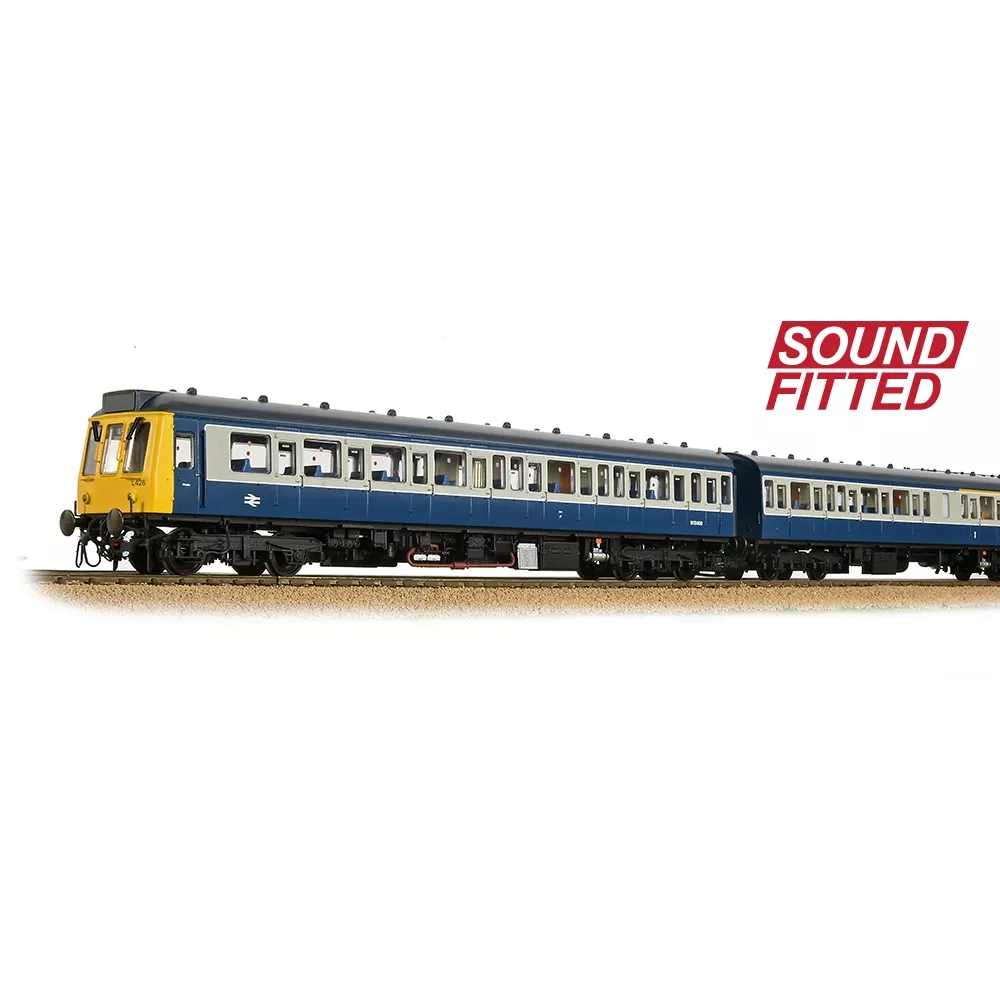
Manufacturer catalogue image - please note that pre-release images may be CAD renders or CGI/AI images rather than photographs
Prototype Eras
Era 7 (1972 to 1982) British Rail Blue (TOPS)
Era 8 (1983 to 1994) British Rail Sectorisation
Manufacturer description
Announced as part of our Winter British Railway Announcements we are delighted to bring you this Class 117 3-Car DMU in BR Blue & Grey livery. With a wealth of individually controllable lighting features, this model is also SOUND FITTED for a fully authentic experience!
Bachmann has designed the Branchline models of the Class 117 and its sibling, the single-car Class 121, from the rails-up, to achieve a new standard in fidelity to prototype in OO scale DMUs. The model is equipped with a low profile, underfloor driveline that permits reproduction of an unprecedented level of interior detail, with no intrusion from the motor.
Our SOUND FITTED model features realistic running sounds and much more - see full details of the sound functions below.
MODEL FEATURES:
- Bachmann Branchline OO Scale
- Era 7/8
- Pristine BR Blue & Grey livery
- 3-Car Unit No. L426, comprising DMS No. W51406, TCL No. W59516 and DMBS No. W51364
- Destination Blinds for Banbury and Oxford
- Accessory Pack
- NEM Coupling Pockets
- Close Coupling Mechanism
- Interior Cab Lighting
- Directional Lighting
- Illuminated Destination Blinds
- Lighting can be controlled by chassis-mounted switches or via DCC
- SOUND FITTED - See below for function list
- Length 850mm (over couplings)
SOUNDS
F0 - Directional Lights - On/Off
F1 - Warm Engine Start-up / Shut-down (with F5 On - Cold Engine Start-up)
F2 - Brake
F3 - Single Horn (Speed & Direction Dependent)
F4 – Two-Tone Horn (Speed & Direction Dependent)
F5 - Cold Start (engage F5 before F1) / Light Load
F6 - Engine Cruise / Compressor Speed-up
F7 - Flange Squeal (at Speed Steps 1-39 of 127)
F8 - Detonators (Speed Variable)
F9 - Saloon Lighting - On/Off
F10 - Guard’s Whistle
F11 - Crawler Mode (Low speed & sounds only)
F12 - On - Guard’s Single Buzzer / Off - Driver’s Single Buzzer Response
F13 - On - Guard’s Double Buzzer / Off - Driver’s Double Buzzer Response
F14 - On - Driver’s Door Open / Off - Driver’s Door Closed
F15 - Passenger Door Slam (Before moving)
F16 - DMS Destination Blind Light - On/Off
F17 - DMBS Destination Blind Light - On/Off
F18 - Fade All Sounds
F19 - Windscreen Wipers
F20 - DMS Directional Lights - Off/On
F21 - DMBS Directional Lights - Off/On
F22 - Rail Join Clatter - Off/On (Speed Variable)
F23 - On - Passenger Door Open / Off - Passenger Door Closed
F24 - Cab Lights - On/Off
F25 - Handbrake
F26 - Air Tank Drain Down
F27 - Volume Down
F28 - Volume Up
Analogue Users: Please note that normal load running sounds and any other automatic or randomised sounds will also operate when this model is used on analogue control (DC) straight from the box!
CLASS 117 HISTORY
The BR Class 117 diesel multiple units (DMUs) were built by Pressed Steel from 1959 to 1961. When first introduced, these three-car units were all based with the similar Class 121 single carriage (railcar) units on British Railway’s Western Region for suburban work out of London Paddington. The units were largely based at Reading and Southall depots and they remained here for many years working these services.
Withdrawal of other DMUs facilitated moves for some units from the Western Region to Birmingham and Scotland, prior to the delivery of new units to replace them. They were given refurbishments. The first shake up in ownership occurred in the late 1980s, when the Scottish, Welsh, Cornish and Birmingham based units were transferred to Provincial Services, later Regional Railways, in the sectorisation of British Rail, while the Southall-based units transferred to Network SouthEast. They were replaced on the lines out of Paddington when the Class 165/1 'Network Turbo' units came into service in November 1992.
They remained in service on the former Western Region until replaced by Class 150 and Class 153 DMUs during 1993. An attempt was made to remove them from Cornish work using Class 142 ‘Pacer’ units, but these non-bogie units proved to be a liability on the tight curves of the Cornish branches, increasing rail and wheel wear, and so the Pacers were moved to the North of England instead. They were finally replaced when Class 150s and Class 153s became available, having been freed up from other areas. They continued to work in Scotland until January 1998 where they were replaced with Class 156s.
For many years, passenger services on the Birmingham Cross-City Line were worked by elderly Class 117, along with Class 115, 116, 118 and 121 diesel multiple units, but all were withdrawn from service by 1995. In 2000, Class 150 Sprinter units replaced the Class 117 units on Silverlink, finally bringing to an end decades of service on Britain's rail network.
Catalogue listing
Model details
Pickup in tender
Interior lighting
Prototype information
ScotRail
Silverlink
* Class names often change over the lifespan of a locomotive, so this is not necessarily the class name used by the operator in the period modelled.
Supplier Links


Supplier links are provided for your convenience and do not guarantee that the product is currently available. RailwayModels.uk is not a representative of these suppliers, but may receive a commission when purchases are made through links on this page.
Related products
-
Bachmann
35-500SF
Class 117 3-Car DMU BR Green (Speed Whiskers)
-
Bachmann
35-502SF
Class 117 3-Car DMU BR Network SouthEast (Revised)
-
Bachmann
35-502
Class 117 3-Car DMU BR Network SouthEast (Revised)
-
Bachmann
35-500
Class 117 3-Car DMU BR Green (Speed Whiskers)
-
Bachmann
35-501
Class 117 3-Car DMU BR Blue & Grey
-
Bachmann
35-505
Class 117 3-Car DMU 117308 BR Regional Railways
-
Bachmann
35-503SF
Class 117 3-Car DMU R334 BR Green (Small Yellow Panels)
-
Bachmann
35-503
Class 117 3-Car DMU R334 BR Green (Small Yellow Panels)
-
Bachmann
35-504SF
Class 117 3-Car DMU L412 BR Blue
-
Bachmann
35-504
Class 117 3-Car DMU L412 BR Blue
-
Bachmann
35-505SF
Class 117 3-Car DMU 117308 BR Regional Railways
-
Bachmann
35-500Z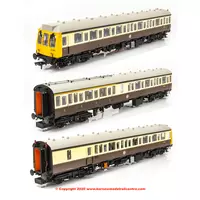
Class 117 3 Car DMU Set number B430 GW 150
This OO scale model represents a three-car Class 117 diesel multiple unit, featuring a low-profile, underfloor driveline that allows for an unobstructed interior. The unit includes comprehensive lighting features, such as interior cab lighting, directional lights, and illuminated destination blinds, which are adjustable via chassis-mounted switches or digital control.
The set comprises unit number L426, consisting of a driving motor second, a trailer composite lavatory, and a driving motor brake second vehicle. The model is supplied with an accessory pack, NEM coupling pockets, and a close coupling mechanism, and comes factory-fitted with a sound system that provides a wide range of operational and environmental effects.