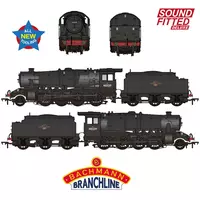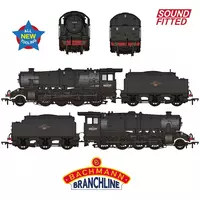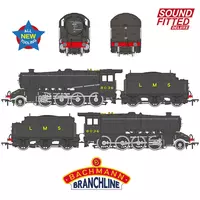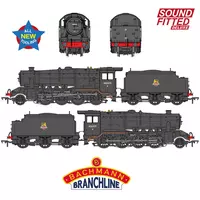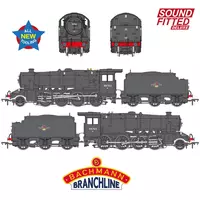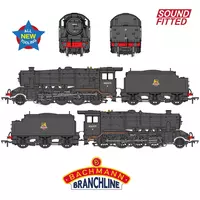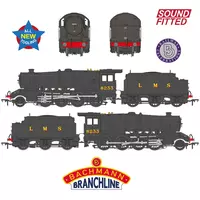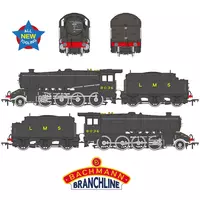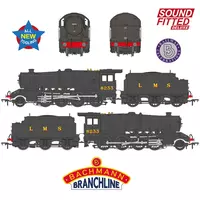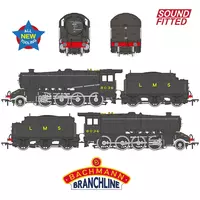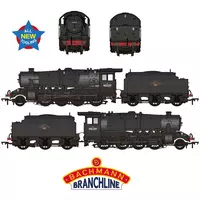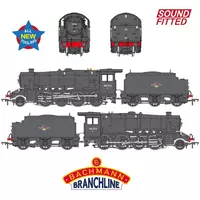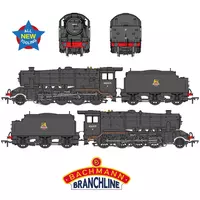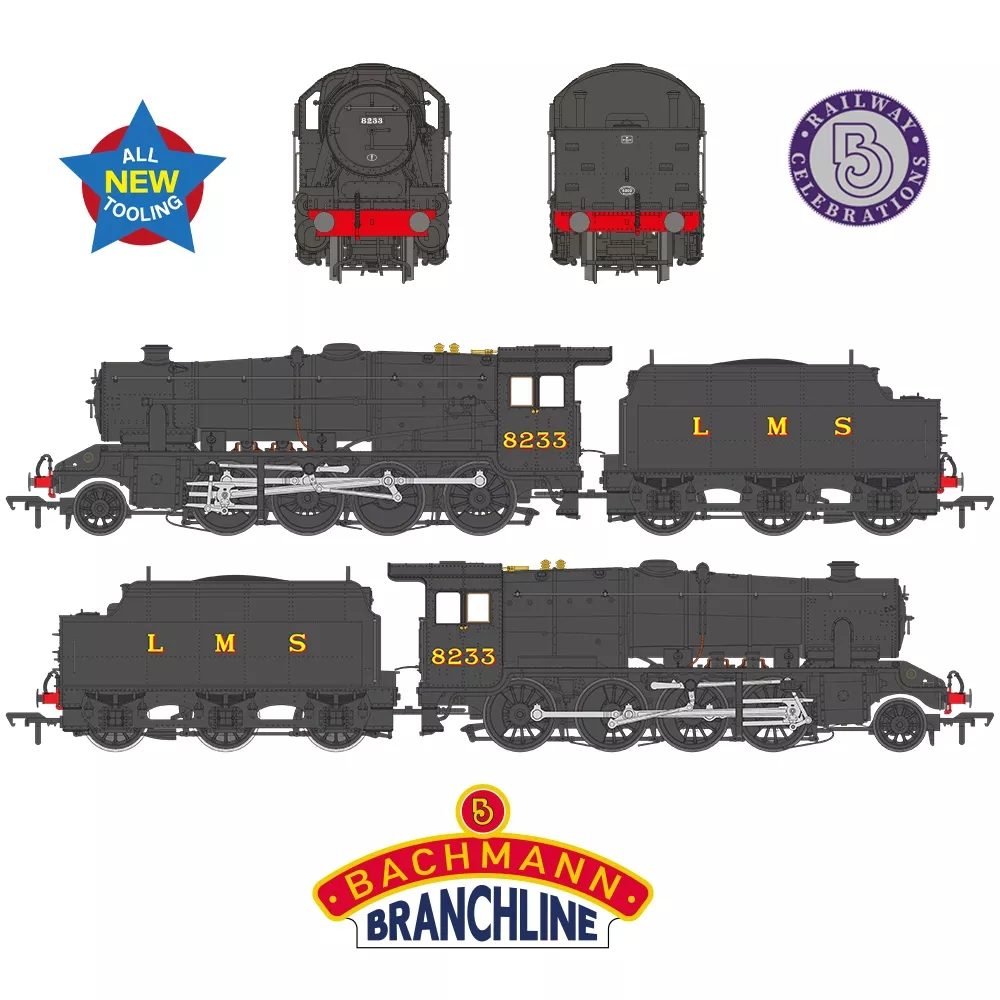
Manufacturer catalogue image - please note that pre-release images may be CAD renders or CGI/AI images rather than photographs
Prototype Eras
Era 3 (1923 to 1947) The Big Four (LNER, LMS, GWR and SR)
Era 7 (1972 to 1982) British Rail Blue (TOPS)
Manufacturer description
The Stanier 8F is an all-time icon of British locomotive design, few other classes were as numerous as the 8Fs and they played a vital role in the allied victory during World War Two, yet surprisingly OO Scale models of this unsung hero have never been produced by Bachmann Branchline, until now. With an award winning model of the 8F already part of the Graham Farish N Scale portfolio, we’ve answered the countless requests to make a model just as good for OO too, and with even finer detail and new features that simply aren’t available in the smaller scale, the Branchline model is the ultimate rendition of Stanier’s ultimate freight machine.
Constructed from a diecast metal boiler, running plate and chassis, the Branchline 8F certainly packs a punch and its strong, powerful performance is coupled with the latest technological features like the firebox lighting system, Bach-Up Stay Alive System and Dual Fitted speakers. SOUND FITTED models take advantage of the Dual Fitted speakers to provide realistic sound effects while the SOUND FITTED DELUXE versions take things a step further with Bachmann’s revolutionary Auto-Release Couplings fitted to the tender providing hands-free, automated uncoupling at the press of a DCC function key. With a comprehensive tooling suite, the various detail differences seen across the 8F fleet can be replicated along with a choice of three tenders so that many of the 800+ locomotives can be accurately portrayed at any given time in their operation career.
No. 8233 (BR No. 48773) is now preserved and in 1975 took part in the celebrations marking the 150th anniversary of the opening of the Stockton & Darlington Railway. The locomotive appeared in LMS Black livery and this is the condition chosen for the Branchline model which will be supplied in special Railway Celebrations packaging.
- Bachmann Branchline OO Scale
- Era 7
- Locomotive is now Preserved
- Pristine LMS Black Livery
- Running No. 8233
- Equipped with a Plux22 DCC Decoder Socket – recommended Decoder item No. 36-570A
- Length 260mm (over couplings)
- Part of our Railway Celebrations Range
DETAIL VARIATIONS SPECIFIC TO THIS MODEL
- Riveted Stanier 4,000-gallon Tender
- Smokebox Door with Small Numberplate
- High Front Lamp Iron (Top)
- Curved Reverser Rod
- Steam Lance Valve Mounted High on the Smokebox
- Countersunk Bufferbeam Rivets
- Fabricated Wheel Balance Weights
BACHMANN BRANCHLINE LMS 8F SPECIFICATION
MECHANISM:
- Coreless motor mounted in the locomotive, driving the third set of driving wheels
- Electrical pickup from all driving wheels along with tender pickups
- Separate metal bearings fitted to each driving axle
- Diecast metal chassis block (locomotive)
- Diecast metal gearbox, with gearing arranged for prototypical running speeds and haulage capabilities
- 16.5mm (OO gauge) wheels to NEM310 & NEM311 standards with authentic profile and detailing
- Valve gear of metal construction
- Adjustable tender drawbar with integral loco-tender wiring
- Sprung front pony truck with integral coupling pocket to NEM362 standards
- Detachable coupling pocket to NEM362 standards fitted to the tender
- Auto-Release Couplings fitted to the tender – DCC operated, hands-free uncoupling with the press of a function button (SOUND FITTED DELUXE models only)
- Designed to operate on curves of second radius (438mm) or greater
DETAILING:
- Diecast metal running plate and boiler
- Precision moulded cab, tender tank and tender chassis
- Separately applied details including smokebox door, smokebox saddle, front frame extensions, steam pipes, lubricators, reverser and sandboxes
- Individual metal detail components including handrails, handrail knobs, boiler feeds, lamp irons, safety valves, sandpipes and tender vents
- Highly detailed and decorated cab interior including controls, dials, gauges and tool cabinets with separately fitted valve wheels, regulator, reverser and crew seats
- Hinged and posable metal fall plate between the locomotive and tender
- Tender fitted with coal-effect load
- Running gear detailing includes brakes and separately fitted brake gear on the locomotive and tender
- Glazed cab windows
- Sprung metal buffers
- Each model supplied with an accessory pack including cab doors, screwlink couplings, front steps and cylinder draincocks
LIGHTING:
- Firebox Glow (on analogue) / Firebox Glow & Flicker (on DCC or when SOUND FITTED & SOUND FITTED DELUXE models are used on analogue)
DCC:
- Plux22 DCC decoder interface located in the locomotive
- Bach-Up Stay Alive Systemproviding uninterrupted power to prevent stalling, light flicker and sound cut-outs (operates on DCC only)
SOUND:
- Dual Fitted speakers, one in the locomotive and one in the tender, installed in all models for optimum sound reproduction
- Zimo MS450P22 DCC Sound Decoder fitted to SOUND FITTED & SOUND FITTED DELUXE versions
- Sound files produced specifically for the Bachmann Branchline 8F using recordings from real locomotives
- SOUND FITTED & SOUND FITTED DELUXE models operate on DCC and Analogue control as supplied
LIVERY APPLICATION:
- Authentic liveries applied to all models
- Multiple paint applications employed on each model
- Logos, numerals and text added as appropriate using multi-stage tampo printing incorporating authentic typefaces, logos and colours
LMS 8F HISTORY
The first of Stanier’s 2-8-0 8Fs emerged from Crewe Works in 1935, one of 331 locomotives ordered by the LMS, however by 1945 a total of 852 8Fs had been built. The extra 521 came about as a result of their engineer Robert Riddles being seconded to the Ministry of Supply during World War Two. Riddles halted an order for ROD 2-8-0s, the engines that had proved so important during the First World War, and instead chose the Stanier 8F as the War Department’s standard steam locomotive for the Second World War.
The ministry of supply ordered 208 for the War Department, meanwhile 245 were ordered for the LMS by the Railway Executive Committee who had taken control of the Big 4 during the conflict. These were built by the SR, GWR and LNER, the latter pair effectively keeping the locomotives that they constructed on loan until peacetime returned. Add to this 68 locomotives that the LNER decided to order for its own fleet, becoming the Class O6, of which 43 were built in-house at Doncaster and Darlington and 25 came from Brighton Works.
The War Department locomotives were shipped primarily overseas, serving with the Middle East Forces of the British Army. Many did not return, having been either lost in transit, lost in battle or sold to the state railways in the countries they had served in once their turn in action was over.
In 1948 British Railways inherited 624 8Fs upon Nationalisation, these being the majority of the LMS fleet give or take a few dozen that were requisitioned, and those operated by the GWR and LNER. Following repatriations and the return of surplus locomotives to BR from military use, the 8F fleet peaked at 666 engines between 1957 and 1960, when the first succumbed to withdrawal. With few exceptions they were allocated to the London Midland Region and found plentiful work hauling all manner of goods plus summer weekend workings and excursion traffic where they turned their hand to passenger haulage with ease.
It would be 1964 before withdrawals reached double figures and by the start of 1968, the final year of steam on British Rail, 150 8Fs were still in traffic, centred around the final bastion of steam in the North West of England. 8F No. 48518 would take responsibility for the final steam-hauled goods train on BR on 3rd August, followed on the 4th, the final day or ‘normal’ steam, by No. 48773 hauling a leg of the Locomotive Club of Great Britain’s ‘Farewell to Steam Railtour’.
Preservation dealt the 8F a meagre hand with just eight of the 852 locomotives built still extant in the UK today. A further six can be found abroad in Turkey, Israel and Iraq, bringing the total to 14 survivors.
Catalogue listing
Model details
Prototype information
* Class names often change over the lifespan of a locomotive, so this is not necessarily the class name used by the operator in the period modelled.
Supplier Links


Supplier links are provided for your convenience and do not guarantee that the product is currently available. RailwayModels.uk is not a representative of these suppliers, but may receive a commission when purchases are made through links on this page.