Bachmann 35-110K
Class 41 HSDT Twin Pack 41001 & 41002 BR Grey & Blue
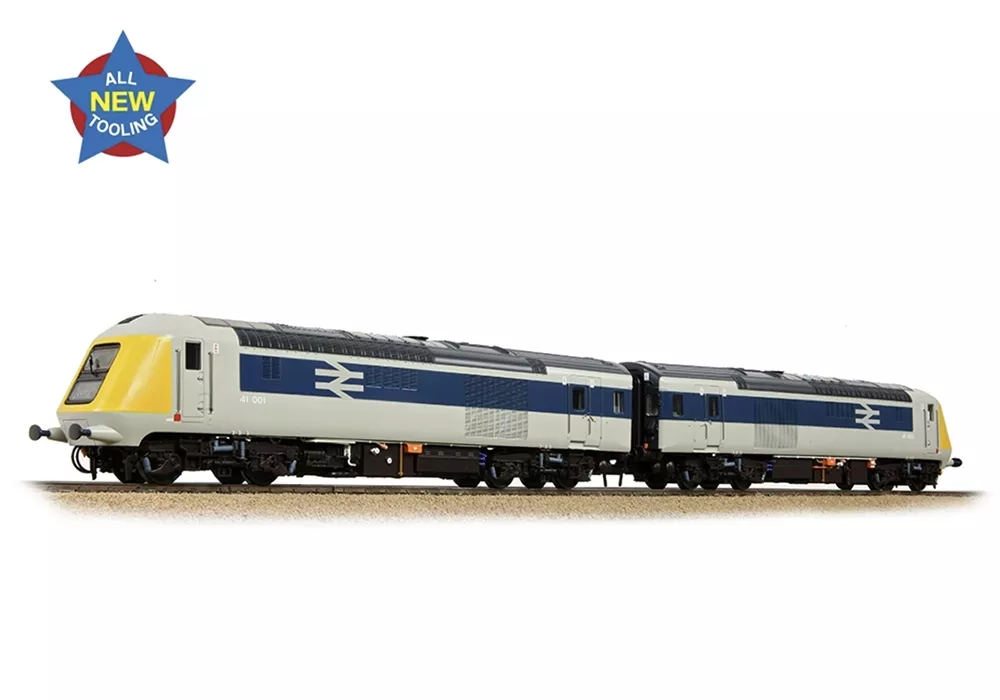
Manufacturer catalogue image - please note that pre-release images may be CAD renders or CGI/AI images rather than photographs
Prototype Era
Era 7 (1972 to 1982) British Rail Blue (TOPS)
Manufacturer description
We are delighted to welcome Bachmann Branchline’s stunning rendition of the Prototype Power Car from the High Speed Diesel Train (HSDT – otherwise known as the HST) to the Bachmann Collectors Club range, with this twin pack of power cars depicting the two prototypes, Nos. 41001 and 41002, when they first entered service in 1972. The power cars were part of the prototype HST set, which paved the way for the production series of which a total of 95 sets were built and after a service life spanning five decades has gone down in history as one of Britain’s most iconic trains.
This twin pack contains two fully functional, high specification models, each of which is motorised and includes our Dual Speaker system pre-fitted along with a comprehensive lighting suite.
MODEL FEATURES:
- Bachmann Branchline OO Scale
- Era 7
- Pristine BR Grey & Blue livery
- Running Nos. 41001 & 41002
- Two Unit Pack (includes two full-specification, motorised Power Cars)
- Equipped with a Plux22 DCC Decoder Socket – Recommend Decoder item No. 36-570B
- Length 2 x 240mm (over couplings)
BACHMANN BRANCHLINE CLASS 41 HSDT SPECIFICATION
MECHANISM:
- Five pole, twin shaft motor with two flywheels providing drive to both bogies
- All axle drive
- Electrical pickup from all wheels
- Separate metal bearings fitted to each axle
- Diecast metal chassis block
- Diecast metal gearboxes, with gearing arranged for prototypical running speeds and haulage capabilities
- 5mm (OO gauge) wheels to NEM310 & NEM311 standards with authentic profile and disc brake detailing
- Tension Lock coupling mounted via a coupling pocket to NEM362 standards fitted to a body-mounted, close-coupling mechanism at the inner end
- Designed to operate on curves of second radius (438mm) or greater
DETAILING:
- Bogies constructed from multiple components featuring full relief detail
- Separately applied metal detail parts, including grab handles, windscreen wipers, lamp bracket and ETH cables
- Separately fitted underframe equipment, pipework and conduits
- Sprung metal buffers
- Each model supplied with a full set of decorated bufferbeam pipework and accessory parts
LIGHTING:
- Directional lighting, including headlights, marker lights and tail lights, all of which are switchable on/off at either end on DCC or Analogue control*
- Cab lighting, switchable on DCC or Analogue control*
- Guard’s Compartment lighting, switchable on DCC or Analogue control*
- Authentic light colours and temperatures selected for each light application
*Switching of lights on Analogue control is by means of the chassis mounted switches
DCC:
- Plux22 DCC decoder interface
SOUND:
- Dual Fitted with two quality speakers employed for optimum sound reproduction
- Zimo MS450P22 DCC Sound Decoder fitted to SOUND FITTED versions
- Sound files for each project produced specifically for the Bachmann Branchline Class 41 HSDT using recordings from real locomotives
- SOUND FITTED models operate on DCC and Analogue control as supplied. On Analogue, an authentic engine start up sequence and running sounds are produced when power is applied
LIVERY APPLICATION:
- Authentic liveries applied to all models
- Multiple paint applications employed on each model using BR and corporate specification colours
- Logos, numerals and text added as appropriate using multi-stage tampo printing using authentic typefaces, logos and colours
- using multi-stage tampo printing using authentic typefaces, logos and colours
CLASS 41 PROTOTYPE HSDT POWER CAR HISTORY
During the 1960s, in its quest for high speed travel and reduced journey times, British Rail set about developing new trains that could run at an increased line speed of 125mph. The HSDT was one solution, and a prototype train was authorised by British Rail in August 1970, with the first vehicles delivered to the Railway Technical Centre (RTC) for testing and type approval less than two years later in the summer of 1972.
Conceived by the Railway Technical Centre, the train owed a great deal of its design to the Western Region, as many of the RTC’s design staff came from Swindon. The experimental train comprised two power cars, along with a set of carriages that would be the prototypes for BR’s Mk3 coaching stock. The power cars were built by British Rail Engineering Limited (BREL) at Crewe Works, whilst the Mk3s were constructed at BREL’s Litchurch Lane site in Derby. Under the Total Operations Processing System (TOPS) the power cars were designated Class 41, with the complete train allocated Class 252.
With development of the Advance Passenger Train (APT) ongoing alongside that of the HST, many saw the APT as the future of British rail travel, with the HST being little more than a stopgap. However, whilst the APT project suffered repeated delays, the prototype HST had already entered service and was such a success that production versions were quickly ordered. Various changes were made between the prototype and production trains, most notably the revised front end of the power cars. A total of 95 production High Speed Trains were built and the HST went on to become one of the most successful trains to have operated on the British railway network.
With the introduction of the production HSTs, the prototype power cars were withdrawn from serviced in late-1976 and both entered Departmental stock, returning to the RTC in Derby where they were used to haul various test trains for a number of years. By the mid-1980s the two vehicles had been stored out of use and whilst one was later scrapped, the other, No. 41001, was preserved as part of the National Collection and now takes pride of place at the National Railway Museum’s Locomotion Museum in Shildon, Country Durham.
Catalogue listing
Model details
Directional lighting
Interior lighting
Supplier Links


Supplier links are provided for your convenience and do not guarantee that the product is currently available. RailwayModels.uk is not a representative of these suppliers, but may receive a commission when purchases are made through links on this page.