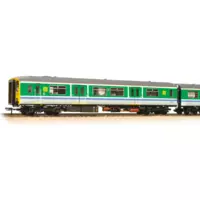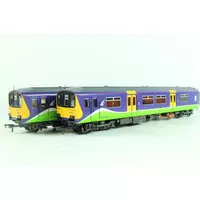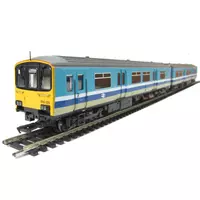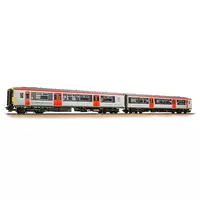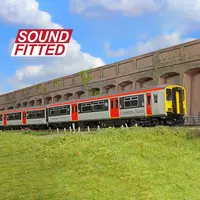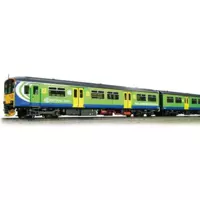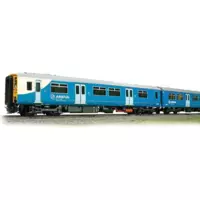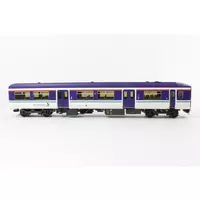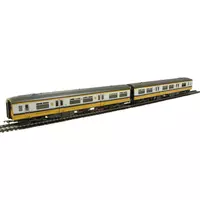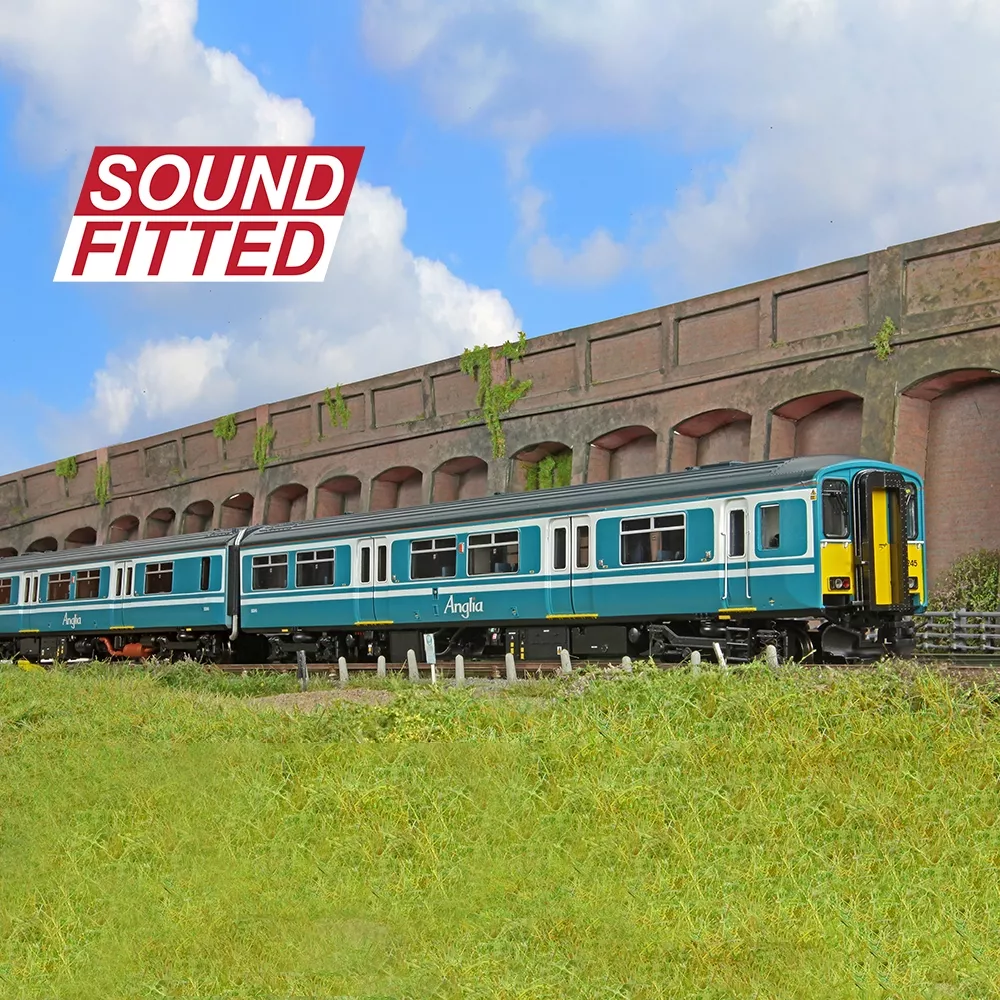
Manufacturer catalogue image - please note that pre-release images may be CAD renders or CGI/AI images rather than photographs
Prototype Era
Era 9 (1995 to 2004) Initial Privatisation
Manufacturer description
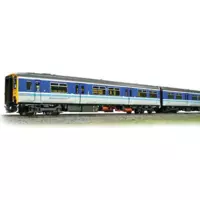
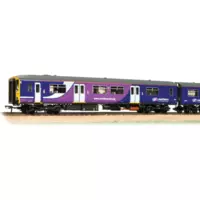
The Class 150 Diesel Multiple Unit (DMU) is an enduring design, first introduced in 1984 with much of the fleet remaining in service today. For the first time, the vibrant turquoise and white livery of historical operator Anglia Railways adorns the Branchline Class 150 DMU, on unit number 150245. The 150/2 sub-class is characterised by the gangway doors fitted to the cab ends, allowing two or more units to work in multiple whilst allowing access from one unit to another.
Constructed from a highly detailed bodyshell which is adorned with separate components like the cab front handrails, gangway connectors and exhaust, the Branchline model replicates the Class 150/2 faithfully. The underframe boasts a suite of parts to depict the engine, drive train, electrical gear and auxiliary equipment, while inside the model, passenger seating is included along with cab detail. The livery application, using authentic colours and accurate typefaces and logos just enhances the model’s good looks, while the powerful and smooth drive mechanism and pre-fitted DCC decoders in this SOUND FITTED model makes the Class 150 DMU the perfect addition to any 2000s era OO scale collection.
This model is a sales area exclusive and is only available from stockists in East Anglia, London and the South East.
MODEL FEATURES:
- Bachmann Branchline OO Scale
- Era 9
- Pristine Anglia livery
- Running No. 150245
- Comprises Car Nos. 52245 and 57245
- Destination Blinds for Peterborough and Ipswich
- Accessory Pack
- NEM Coupling Pockets
- Powerful 5 Pole Motor with Flywheel
- Interior Detailing and Lighting
- Directional Lighting
- Speaker Fitted
- SOUND FITTED – Fitted with an ESU Loksound V5DCC Sound Decoder
- Length 540mm
DCC SOUND OPTIONS
- F0 Lights
- F1 Sound On/Off
- F2 Brake
- F3 Horn (Playable)
- F4 Double Toot Horn
- F5 Heavy Load
- F6 Coasting
- F7 Maximum Revs
- F8 Coupling/Uncoupling
- F9 Flange Squeal
- F10 Carriage Doors
- F11 Spirax Valve
- F12 Guards Whistle/Drivers Response
- F13 Compressed Air
- F14 Uncoupling Cycle
- F15 Air Build Up
- F16 Carriage Heating
- F17 AWS
- F18 Sound Fade Up/Down
- F19 Mute
- F20 Station Announcement
- F21 Manual Notching
- F22 Sanding Valve
- F23 Fire Bell Test
CLASS 150 DMU HISTORY
The British Rail Class 150 ‘Sprinter’ is a class of diesel multiple unit passenger train built by BREL York from 1984 to 1987. A total of 137 units were produced in three main subclasses, replacing many of the earlier, first generation ‘heritage’ DMUs. The first subclass, the 150/0, comprised a pair of prototype units.
The second batch which comprised fifty units was classified 150/1s and numbered in the range 150101-150. Like the prototype units, they did not have front-end corridor connectors which are fitted to allow passengers to move between units when working in multiple. Originally based at Derby Etches Park depot, these units were introduced in 1986, mainly concentrated around Birmingham and Manchester, and in later years restricted mainly to commuter services. Today most of the fleet is concentrated on the Northern franchise, mainly working around Manchester to places like Buxton, Sheffield, Liverpool, Southport and Carnforth. The remaining operational Class 150/1’s are in use with London Northwestern Railway, on the Marston Vale line between Bletchley and Bedford.
The final batch of 85 two car units were built with front-end corridor connectors. These units were classified as Class 150/2s and numbered in the range 150201-285. The Class 150/2s were used on longer-distance services and have operated in Scotland, Wales, the West of England and the North.
Catalogue listing
Model details
Interior lighting
Prototype information
* Class names often change over the lifespan of a locomotive, so this is not necessarily the class name used by the operator in the period modelled.
Supplier Links


Supplier links are provided for your convenience and do not guarantee that the product is currently available. RailwayModels.uk is not a representative of these suppliers, but may receive a commission when purchases are made through links on this page.