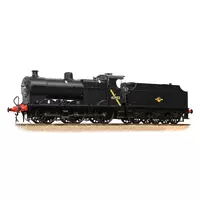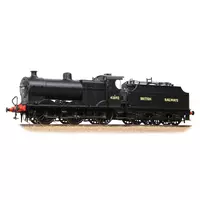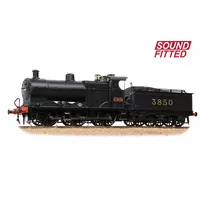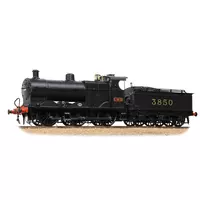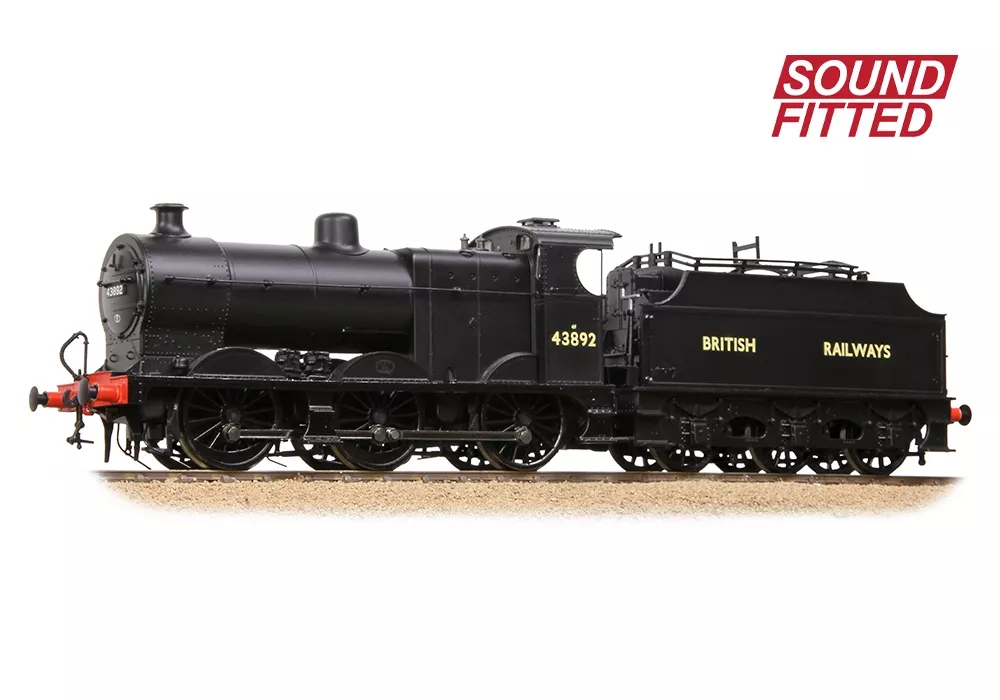
Manufacturer catalogue image - please note that pre-release images may be CAD renders or CGI/AI images rather than photographs
Prototype Era
Era 4 (1948 to 1956) British Railways Early Crest
Manufacturer description
The LMS 4F was seen as the ultimate development of the humble 0-6-0 tender locomotive, and the Bachmann Branchline model is a faithful OO Scale replica of this iconic type. First borne by the Midland Railway (MR) in 1911, the 4Fs remained in traffic until the final days of BR steam but we’re depicting No. 43892 at the start of its BR career with British Railways wording on its Fowler tender, as seen soon after BR was formed in 1948.
The 4Fs were simple yet beautiful machines and the Branchline model pays homage to that with high fidelity mouldings for the main components like the smokebox, boiler, firebox and cab, which are all mounted on a diecast metal running plate. Countless separate detailing parts are then added like the metal handrails, turned brass safety valves, lamp irons and lubricators. Sprung metal buffers are fitted to both bufferbeams.
The locomotive’s diecast chassis is enhanced with brake blocks, brake rigging and sandboxes with separate wire sandpipes, whilst between the frames a representation of the inside motion is present. This attention to detail extends to the tender, while the tender drawbar is adjustable to suit individual layout conditions and electrical connections are incorporated into the drawbar.
Look inside the cab and you will find a sublime level of detail; the boiler backhead boasts an array of separately fitted pipework, controls and dials, all of which are enhanced further with bespoke decoration. A poseable fallplate is fitted to the rear of the cab to complete the look.
The black colour scheme may not seem like the most difficult livery to replicate but the usual care and attention that you expect from Bachmann Branchline has been employed to ensure that the paint finish is rich and consistent throughout. Details like the running number, plates and plaques are then added using precision printing techniques for full authenticity.
The Branchline 4F runs as well as it looks thanks to a power full three pole motor and diecast metal gearbox. The locomotive driving wheels run in separate metal bearings and all six driving wheels are equipped with electrical pickups, tender pickups are included too. Meanwhile, with SOUND FITTED this model is ready to run on analogue and DCC systems and will provide a range of authentic sound effects to bring another level of realism to your model railway.
MODEL FEATURES:
- Bachmann Branchline OO Scale
- Era 4
- Pristine BR Black ‘British Railways’ livery
- Running No. 43892
- Fowler Tender with Water Pickup Gear
- Short Chimney
- Ross Pop Safety Valves
- Fluted Connecting Rods
- Powerful 3 Pole Motor
- Tender Pick-ups
- Adjustable Tender Drawbar
- NEM Coupling Pockets
- Sprung Buffers
- Accessory Pack
- Speaker Fitted
- SOUND FITTED – Fitted with a ESU Loksound V5DCC 21 Pin DCC Sound Decoder
- Length 221mm (over couplings)
MIDLAND 3835 CLASS HISTORY
Designed by Henry Fowler for the Midland Railway (MR), the 3835 Class was first introduced in 1911. Construction of these 0-6-0 freight locomotives was shared between the Midland Railway’s Derby Works and outside contractor Armstrong Whitworth, with 197 examples built by 1922; 192 for the Midland Railway and five for the Somerset and Dorset Joint Railway (S&DJR).
After the Grouping in 1923, the London Midland and Scottish Railway (LMS) inherited all 192 locomotives from the MR (and later the five S&DJR examples when it absorbed that company in 1930) and gave the locos the designation Class 4F. The LMS commenced construction of further 4Fs, much to the same design as the 3835 Class, although the LMS-built locos were left hand drive whereas the original Midland machines were right hand drive.
The 4F was seen as the ultimate development of the 0-6-0 tender locomotive and the type epitomised the British goods engine. The LMS went on to build 575 examples between 1924 and 1941 and all of them, plus the 197 Midland-built locos, entered BR stock following Nationalisation in 1948.
Withdrawals did not commence until 1954, with the 3835 Class all gone by 1965 (the last 4Fs would survive only a year longer), however one MR-built locomotive has survived into preservation, No. 43924. No. 43924 is also notable as being the first locomotive to leave the Woodham Brothers Scrapyard in Barry, South Wales, when it departed in September 1968 for its new home at the Keighley & Worth Valley Railway where the loco is still based today.
Catalogue listing
Model details
Prototype information
* Class names often change over the lifespan of a locomotive, so this is not necessarily the class name used by the operator in the period modelled.
Supplier Links


Supplier links are provided for your convenience and do not guarantee that the product is currently available. RailwayModels.uk is not a representative of these suppliers, but may receive a commission when purchases are made through links on this page.