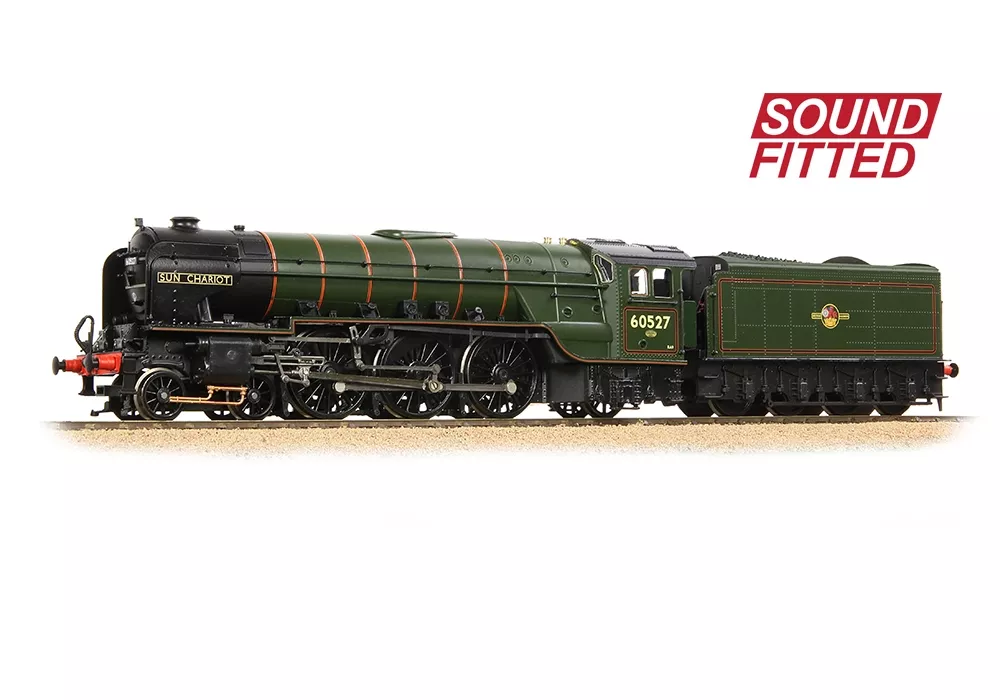
Manufacturer catalogue image - please note that pre-release images may be CAD renders or CGI images rather than photographs
Prototype Era
Era 5 (1956 to 1966) British Railways Late Crest
Manufacturer description
The LNER was well known for its Pacific steam locomotives and when Arthur Peppercorn became Chief Mechanical Engineer in 1946, he took the 4-6-2 designs of his forebears and amended them to produce express locomotives fit for the East Coast mainline and beyond.
This Bachmann Branchline model replicates No. 60527 ‘Sun Chariot’ which was the third of 15 A2s to be built, entering service in January 1948 and remaining in traffic until April 1965, leaving just four of its classmates still in use. The Branchline model is as elegant as its prototype and is built around a diecast metal running plate and chassis. The smokebox, boiler and cab are reproduced using precision injection moulding techniques with numerous details then added including the etched metal smoke deflectors for that characteristic front-end appearance. The model is adorned with metal handrails throughout, plus etched lamp irons in front of which mouldings depicting the LNER’s electric lamps have been added. Sandboxes and lubricators complete the running plate, meanwhile the chassis boasts suspension and brake detail and is finished with separate brake rigging.
The cab interior boasts an authentic boiler backhead, complete with controls, dials, gauges and pipework each decorated individually and with a set of crew seats, glazed cab windows and a hinged cab fallplate. The locomotive to tender drawbar has two settings permitting close coupling where operating conditions allow. The tender itself displays the same level of detail as the locomotive and comes complete with a removable coal load, below which the coal space modelled.
This A2 is brought to life with its exquisite paintwork, with a rich and accurate rendition of the BR Green colour scheme enhanced by the orange and black lining and cream numerals on the cab sides. The BR Late Crests are replicated true to prototype on the tender while nameplates are printed onto the smoke deflectors and etched versions are supplied as accessories for those who like to add that finishing touch.
With a powerful 5 pole motor, 21 Pin DCC Decoder interface and the option of SOUND FITTED, the Branchline A2 is a Pacific worthy of any OO scale roster.
MODEL FEATURES:
- Bachmann Branchline OO Scale
- Era 5
- Pristine BR Lined Green (Late Crest) livery
- Running No. 60527
- Named ‘Sun Chariot’
- Etched Nameplates included
- Powerful 5 Pole Motor
- Adjustable Tender Drawbar
- NEM Coupling Pockets
- Sprung Buffers
- Accessory Pack
- Speaker Fitted
- SOUND FITTED – Fitted with a Zimo MS440C 21 Pin DCC Sound Decoder
- Length 297mm (over couplings)
PEPPERCORN A2 CLASS HISTORY
The Peppercorn A2 Class locomotives were designed by Arthur Peppercorn who was Chief Mechanical Engineer (CME) of the London & North Eastern Railway (LNER) from 1946. The Class totalled 15 examples, all of which had originally been ordered as Class A2/3s by Peppercorn’s predecessor Edward Thompson, however on Thompson’s retirement Peppercorn took the opportunity to amend the design, producing his A2 Class.
The first A2 was completed by the LNER’s Doncaster Works in December 1947, just days before Nationalisation, emerging as No. 525 and named ‘A. H. Peppercorn’ after its designer. The remaining 14 locomotives were completed between January and August 1948 – the first six of these carried their LNER number to begin with whilst the final eight had their BR numbers applied from new. In common with other LNER top link locomotives, every class member was named and with the exception of No. 525, the names were taken from racehorses.
Initial allocations put the Peppercorn A2s at depots along the East Coast Main Line and the locomotives soon proved themselves on a range of traffic, from express passenger services to parcels and postal trains. Being powerful and with a fast turn of speed, they were favoured by Scottish depots for the route between Aberdeen and Edinburgh with its stiff gradients and sharp curves, and five of the class would be stationed north of the border.
The first withdrawal came in 1962, and all of the locomotives based in England had gone the following year, but those working in Scotland survived as late as 1966. One of those engines to make it to 1966 was No. 60532 ‘Blue Peter’ which was saved for preservation after being sold to a private buyer. The locomotive has recently been restored to working order and now operates on the mainline and at heritage railways across the UK.
Catalogue listing
Model details
Supplier Links


Supplier links are provided for your convenience and do not guarantee that the product is currently available. RailwayModels.uk is not a representative of these suppliers, but may receive a commission when purchases are made through links on this page.