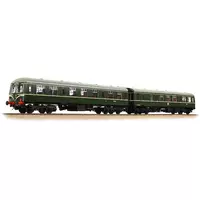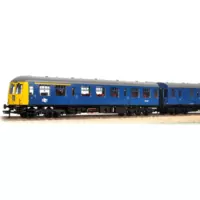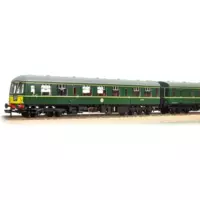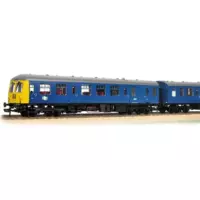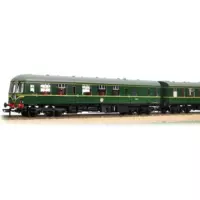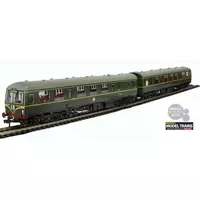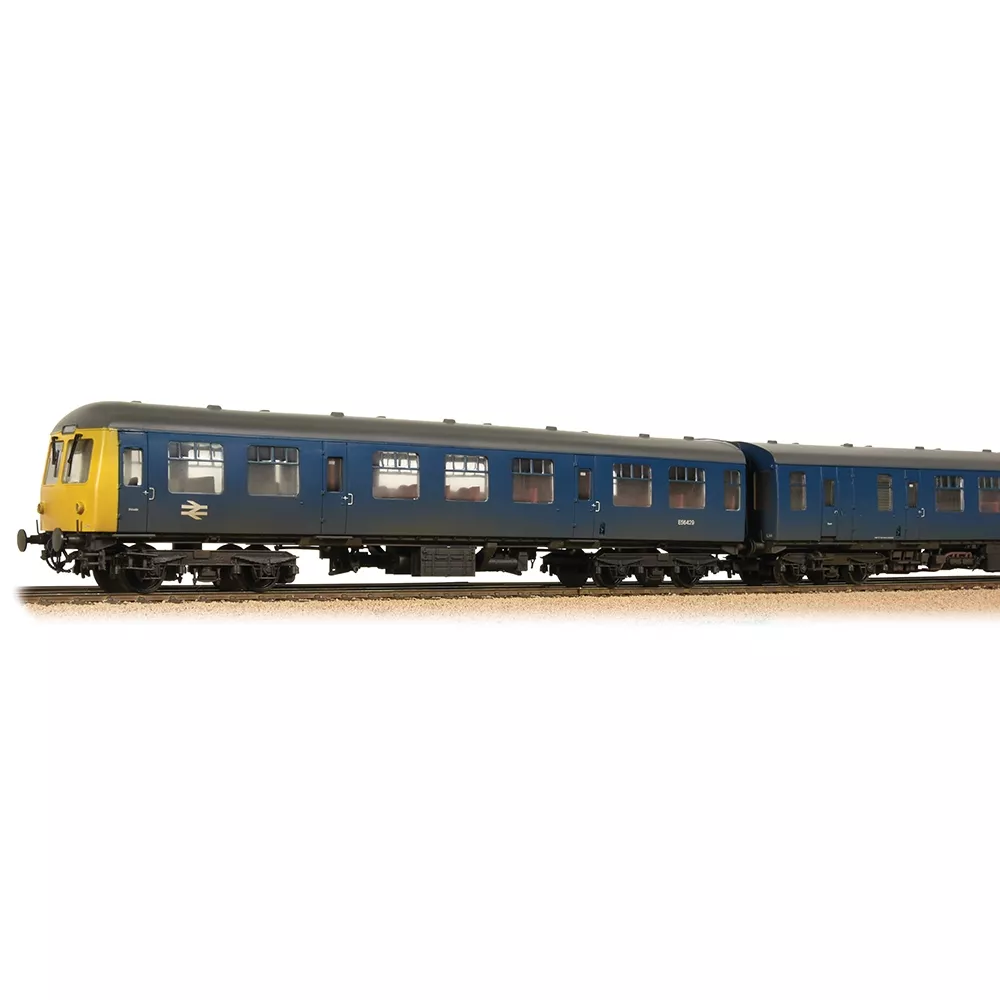
Manufacturer catalogue image - please note that pre-release images may be CAD renders or CGI/AI images rather than photographs
Prototype Eras
Era 6 (1967 to 1972) British Rail Blue (Pre-TOPS)
Era 7 (1972 to 1982) British Rail Blue (TOPS)
Era 8 (1983 to 1994) British Rail Sectorisation
Manufacturer description
The highly popular ‘Cravens’ Class 105 DMU returns for 2022 and this example is finished in BR Blue with an authentic weathered appearance.
Our model of the Cravens Class 105 two-car Diesel Multiple Unit captures the character of these first generation DMUs to a tee. Featuring detailed bodywork and interiors, the bogies have been finely rendered and all of the chassis-mounted equipment is present and correct too. All of these details are highlighted by the exquisite livery application, using BR-specification colours and authentic numbers and logos to produce a multiple unit fit for any British Rail fleet. Powered by a 5 pole motor with a flywheel which ensures smooth running, both vehicles feature directional and interior lighting and illuminated destination blinds.
MODEL FEATURES:
- Bachmann Branchline OO Scale
- Era 7
- Weathered BR Blue Livery
- 2-Car Unit comprising DMBS No. E51282 and DTCL No. E56429
- Destination Blinds for Newcastle and Hexham
- Accessory Pack
- NEM Coupling Pockets
- Powerful 5 Pole Motor with Flywheel
- Sprung Buffers
- Directional Lighting and Illuminated Destination Blinds
- Interior Lighting
- Equipped with 2 x 8 Pin DCC Decoder Sockets – recommended Decoders item No. 36-566
- Length 495mm
Class 105 DMU HISTORY
The British Rail Class 105 Diesel Multiple Units were built by Cravens Ltd. of Sheffield between 1956 and 1959. A total of 302 vehicles were built – each of which shared the same body profile as BR Mark 1 coaching stock – and these were formed into two- and three-car units. Although these Cravens units were used principally on Eastern Region services around Hull, Lincolnshire, East Anglia and local services to/from London King's Cross, the Class was delivered to no fewer than four different regions when first built, with examples also going to the London Midland, North Eastern and Scottish Regions – this variety was unprecedented amongst First Generation DMUs. The majority were two-car sets, with only the Midland Region receiving any quantity of 3-car units. Their looks and similarities to the Mk1, along with other quirks of the type, made for a characterful unit that became popular with enthusiasts.
As traffic requirements changed and transfers occurred, several of the Class that were first assigned to work on the former Midland and Great Northern Joint Railway lines were moved to work in and out of London King's Cross. As lines closed, the Cravens units were dispersed further and examples could be found across the UK, notably at Tyseley depot in Birmingham. The electrification of the lines from London King's Cross and the introduction of the Class 313 EMUs in 1976 saw many Cravens units transferred away to other cities and regions. Although several First Generation DMUs were selected for Refurbishment programmes during the late-1970s, the 105s were not among them and so withdrawals began as newer units were introduced.
Norwich was the last depot to operate the Cravens units, with one unit being returned to green livery, and gaining a somewhat celebrity status towards the end of its service life. The final vehicles were withdrawn from passenger service in 1988, however a small number had already been repurposed for parcels traffic and the final such examples survived until 1989, whilst others found a short reprieve in route learning or Sandite use – but these too had gone by May 1990. The presence of Asbestos deterred most preservations and so ultimately most of the 105s were scrapped, however one two-car set survives at the East Lancashire Railway and has recently returned to traffic after a 20 year refurbishment, whilst a third vehicle survives at the Llangollen Railway.
Catalogue listing
Model details
Directional lighting
Interior lighting
Prototype information
* Class names often change over the lifespan of a locomotive, so this is not necessarily the class name used by the operator in the period modelled.
Supplier Links


Supplier links are provided for your convenience and do not guarantee that the product is currently available. RailwayModels.uk is not a representative of these suppliers, but may receive a commission when purchases are made through links on this page.