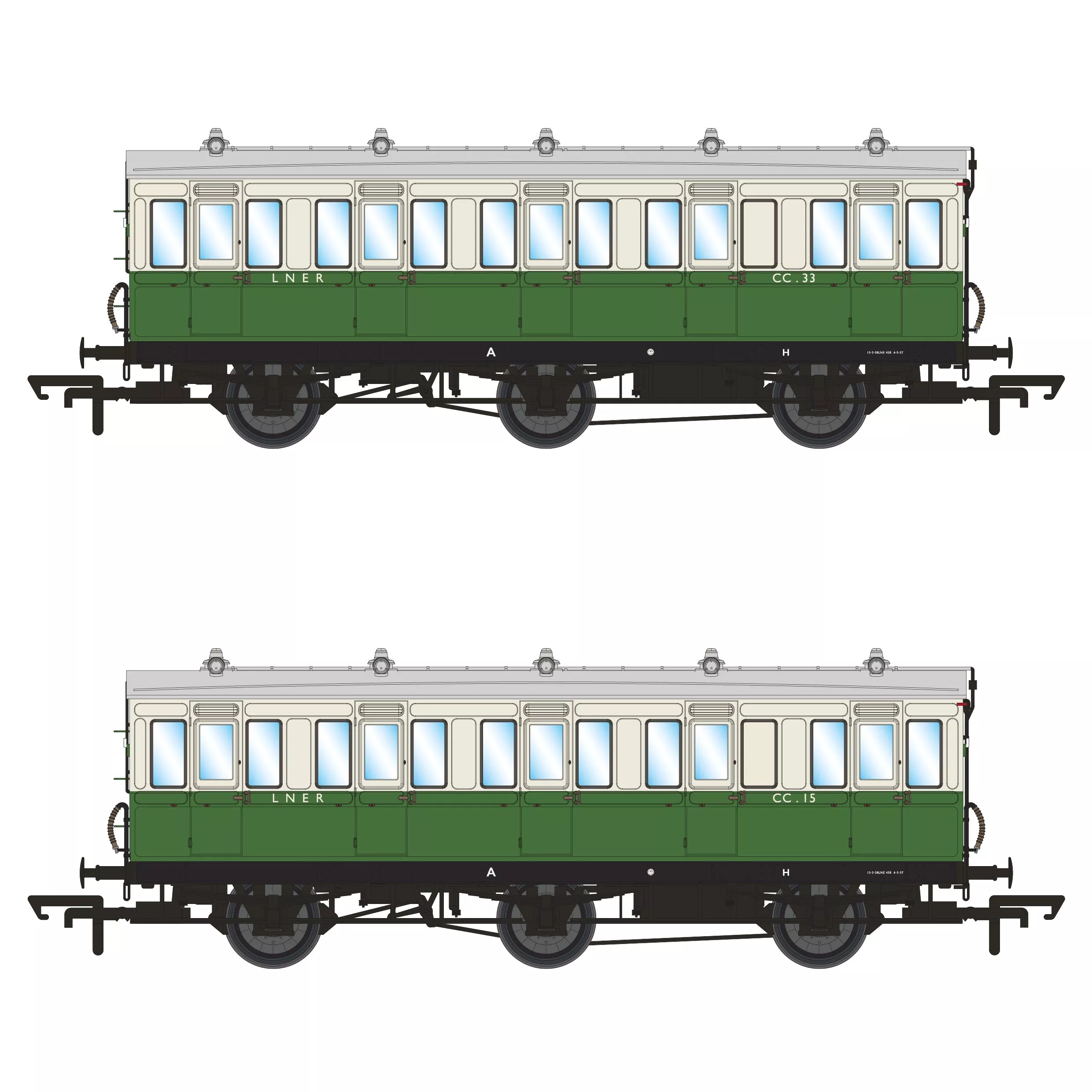
Manufacturer catalogue image - please note that pre-release images may be CAD renders or CGI/AI images rather than photographs
Prototype Era
Era 3 (1923 to 1947) The Big Four (LNER, LMS, GWR and SR)
Manufacturer description
In late 1932, a suggestion was made to the LNER Board that some of the pre-Grouping six-wheeled coaches inherited by the company could be made suitable for camping by placing them at attractive station locations and hiring them out at a reasonable rate. This proposal was sanctioned on June 1, 1933, and the experiment began with the conversion of ten former Great Northern five-compartment six-wheeled coaches. By July 1, 1933, these had been positioned at ten branch line locations in the North-East.
The conversion involved gutting three compartments to create a kitchen and living area, while the remaining two were converted into bedrooms. Access between the various “rooms” was via the external running board. Toilet facilities do not appear to have been provided, so it was assumed that station facilities were to be used, although the sidings were not always in close proximity to them.
The first season was a complete sell-out, with 129 bookings taken at a rental of £2 10s per coach per week, on the condition that parties travelled by rail to their chosen destination. For the 1934 season, a further 25 coaches were converted, with additional locations in the South and Scotland added to the scheme, and by 1938 a total of 118 coaches were in use across these regions.
For the 1935 season, the original teak appearance was considered too drab, and the camping coaches were repainted into the Tourist Train Set livery of green and cream. The word “Camping” was removed from the coach sides and replaced by a CC prefix to the coach number. That same year also saw the introduction of an additional holiday offering in the North Eastern area: the Touring Camping Coach. Unlike the static branch line locations, this coach was moved—with its holiday party on board—from site to site on a pre-arranged schedule, being attached to ordinary train services between destinations. This touring service was available for between £2 2s and £2 10s per person, for a minimum booking of six people.
Catalogue listing
Model details
Prototype information
Supplier Links


Supplier links are provided for your convenience and do not guarantee that the product is currently available. RailwayModels.uk is not a representative of these suppliers, but may receive a commission when purchases are made through links on this page.