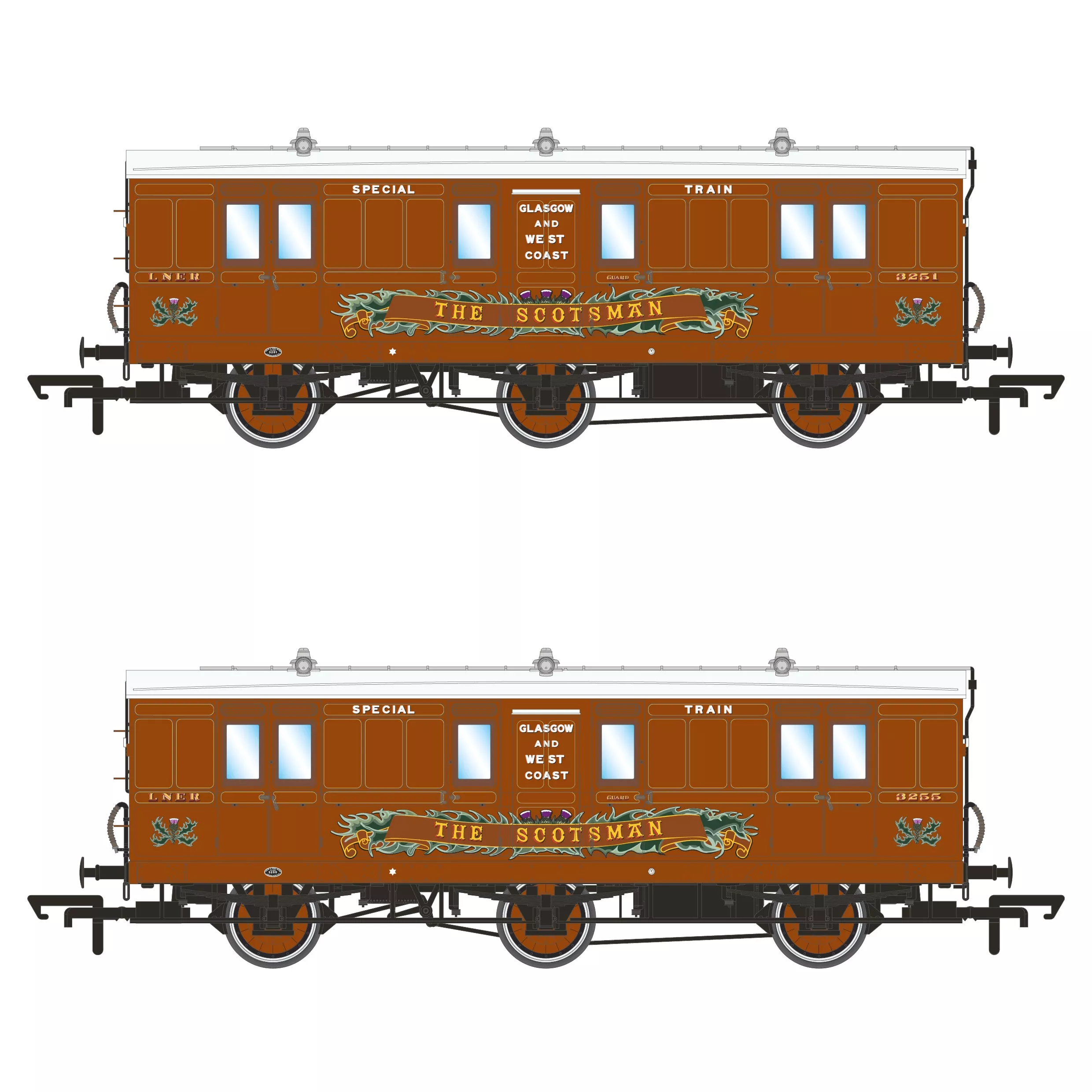
Manufacturer catalogue image - please note that pre-release images may be CAD renders or CGI/AI images rather than photographs
Prototype Era
Era 3 (1923 to 1947) The Big Four (LNER, LMS, GWR and SR)
Manufacturer description
The Scotsman newspaper was first published in Edinburgh on 25 January 1817. Although the railway network expanded during the 1840s, few newspapers initially used railways for distribution because of high freight charges. This changed in 1855 when stamp duty on advertising and newspapers was abolished. The owners of The Scotsman then reached an agreement with Scottish railway companies, under which they paid the carriage fees themselves, effectively creating a railway distribution monopoly for the paper. Circulation quickly increased as it became available across most of Scotland, reaching around 40,000 copies per day by the early 1870s.
This growth in circulation and profits encouraged more effective use of the railway network for distribution. The publishers entered into an agreement with the North British Railway to provide an early morning newspaper express service, using dedicated vans to carry freshly printed copies from Edinburgh at 04:00 to Glasgow for onward distribution on the first morning trains. As circulation continued to grow, an additional newspaper express was introduced in 1899 to carry the paper to Hawick each morning, connecting with the 06:00 passenger train to Riccarton. This enabled towns in the north of England, including Hexham, Langholm, Carlisle, and Newcastle, to receive early deliveries, further increasing circulation.
The Scotsman special newspaper expresses ran for more than 70 years between Edinburgh and Glasgow, with the last service operating around the mid-1940s under the LNER, and the nature of the operation changed little during that time. Each morning, bundles of newspapers leaving the presses at 04:00 were taken to Edinburgh’s Waverley station and loaded onto twelve dedicated “Special Express” carriages in Scotsman livery. During the journey, packers assembled individual parcels for each destination, which were thrown out at stations along the route. At these intermediate stops, the train slowed to around 10 mph to allow parcels to land safely on the platform.
Under the LNER, the dedicated newspaper vans were repainted from North British Railway Coach Lake into the familiar LNER painted teak body finish, with the ends painted black after 1925. The solebar and Mansell wheel centres also received the painted teak finish, while the running gear was painted black. Panel lining followed standard LNER practice in primrose yellow, and The Scotsman’s heraldic banner appeared on both sides, with thistle emblems at each end of the van.
Catalogue listing
Model details
Prototype information
Supplier Links


Supplier links are provided for your convenience and do not guarantee that the product is currently available. RailwayModels.uk is not a representative of these suppliers, but may receive a commission when purchases are made through links on this page.