Manufacturer catalogue image - please note that pre-release images may be CAD renders or CGI/AI images rather than photographs
Prototype Era
Era 2 (1875 to 1923) Pre-grouping
Manufacturer description
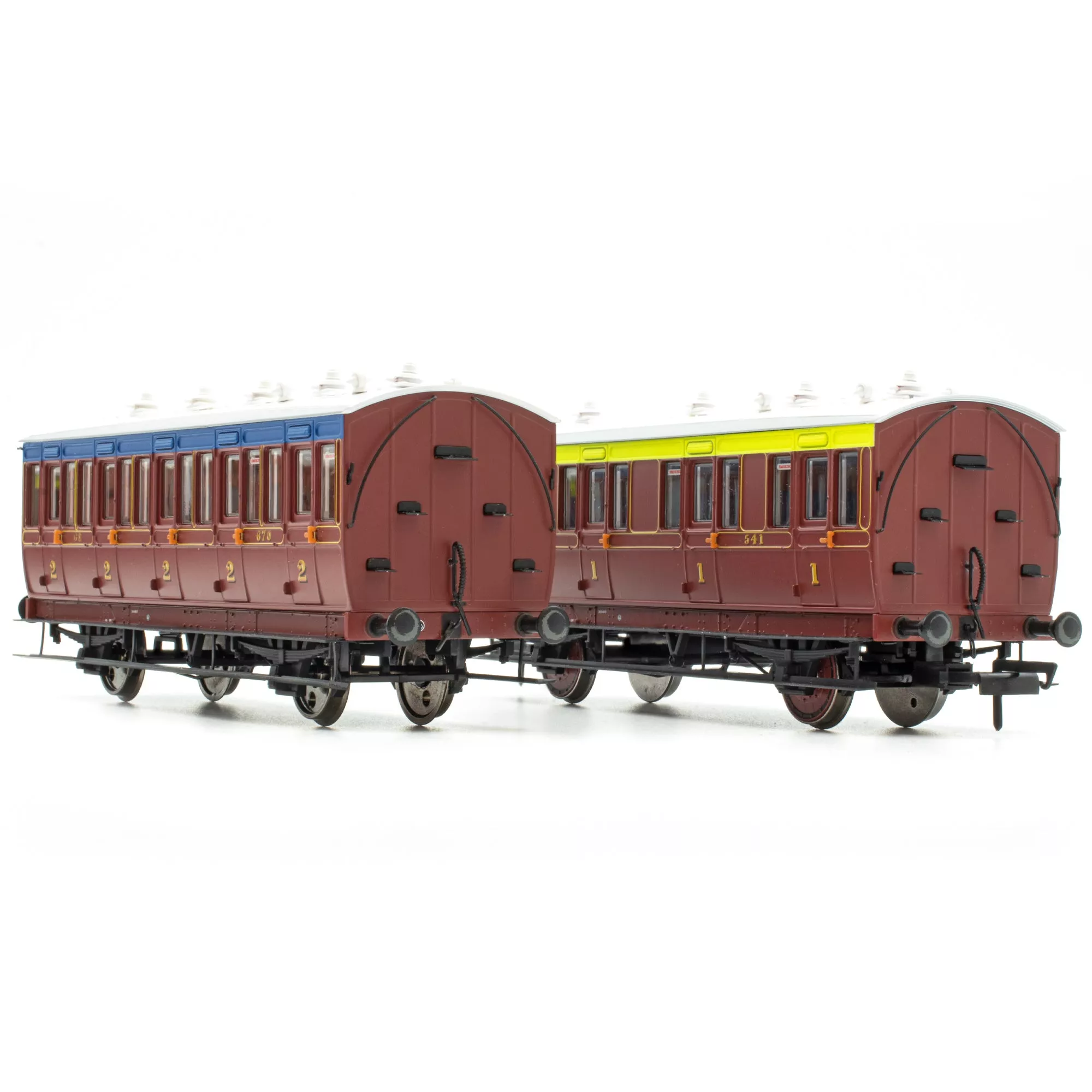
On February 6, 1919, the Great Eastern Railway’s Locomotive Superintendent, Albert Hill, presented his report on replacing varnish as a finish on coaches with painting, his preferred colour being Crimson Lake. With Board approval, this began to be implemented by April 1919. Body sides and ends, along with solebars and headstocks, were painted in Crimson Lake. All running gear below the level of the solebar was black, while the centres of the Mansell wheels were painted either Crimson Lake or black. Roofs were painted white or off-white, along with all roof furniture, though the section of roof between the lower rain strip and the eaves was painted mid-grey.
Body mouldings were picked out in cream or primrose lining, and a new serifed lettering style was adopted, along with smaller class numerals on door panels where possible. As suburban stock, these carriages did not carry the GER armorial device. First- and second-class carriages were instead denoted by the addition of broad colour bands beneath the eaves—chrome yellow for first class and French blue for second.
All trains for the GER’s new suburban timetable of that period, the “Jazz” services, were made up to 16 vehicles, and vehicles from the Enfield Sets have been chosen for representation in this release. To enable the running of short trains, the 16-car rake would be split between the 10th and 11th vehicles, creating 10-car and 6-car portions. The sets were lettered at each end, with “EE” for the 10-car portion and “E” for the 6-car portion, with an additional letter (A, B, C, etc.) denoting the individual set.
Initially, Enfield Sets were split as 12-car and 4-car portions, but this was soon abandoned in favour of the 10/6-car split. The running order was: 3rd Brake, 3rd, 3rd, 3rd, 3rd, 3rd, 2nd, 2nd, 2nd, 2nd, 1st, 2nd, 2nd, 1st, 3rd, 3rd Brake. The portions were divided between the second-class coaches for the 12/4 split and between the second and first for the 10/6 split. Packs A and C build the early 4-car portion, with Pack B adding the two vehicles necessary for the later 6-car portion.
Catalogue listing
Model details
Prototype information
Supplier Links


Supplier links are provided for your convenience and do not guarantee that the product is currently available. RailwayModels.uk is not a representative of these suppliers, but may receive a commission when purchases are made through links on this page.