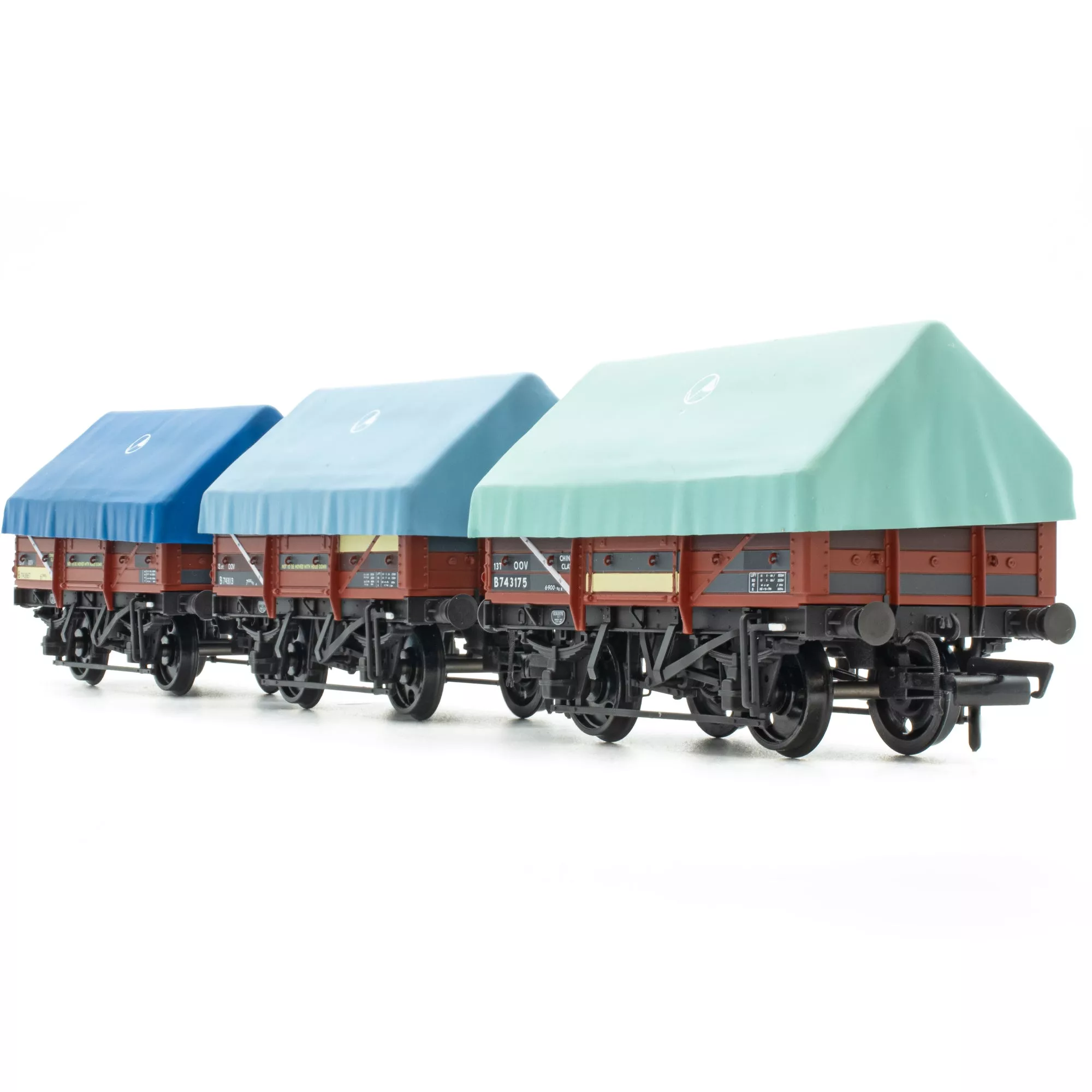
Manufacturer catalogue image - please note that pre-release images may be CAD renders or CGI/AI images rather than photographs
Prototype Eras
Era 7 (1972 to 1982) British Rail Blue (TOPS)
Era 8 (1983 to 1994) British Rail Sectorisation
OOV - Pent Hood - Fitted - 1983 to 1988 - Pack L
BR built a total of 875 of these Kernow icons across several batches from 1954 up until 1960. The "Clayhoods were built to complement and eventually replace the GWR O.13 clay wagons Running in short branchline trains all the way up to 50 wagon mega block trains, this staple of Cornish railway scene were withdrawn and replaced by the air braked CDA wagons in 1988.
Supplier links are provided for your convenience and do not guarantee that the product is currently available. RailwayModels.uk is not a representative of these suppliers, but may receive a commission when purchases are made through links on this page.
Accurascale has released a new model of the British Rail clay hood wagon in Freight Bauxite livery, representing the period of British Rail Blue TOPS. This model is part of a triple pack and features a highly detailed design, constructed from plastic and die-cast metal, with a weight of 42g per wagon.
The model is available in OO gauge and features RP25.110 chemically blackened wheel sets, blackened brass bearings, and etched metal, plastic, and wire detail parts. The model also includes turned sprung metal buffers and NEM standard coupler pockets.
The clay hood wagon has a rich history, with British Rail building a total of 875 wagons between 1954 and 1960. These wagons were built to replace the GWR O.13 clay wagons and were designed to carry China clay, as well as ball clay. The wagons were initially unfitted and later fitted with vacuum brake equipment and repainted in BR Bauxite livery.
The wagons underwent several modifications over the years, including the addition of a pent hood and a tarpaulin bar to prevent rainwater from accumulating and causing damage to the cargo. The wagons were eventually recoded to OOV in 1983 and were withdrawn from service in 1988.
Several of these iconic wagons have survived into preservation and can be found on display in museums and on heritage railways, such as the Bodmin and Wenford Railway.