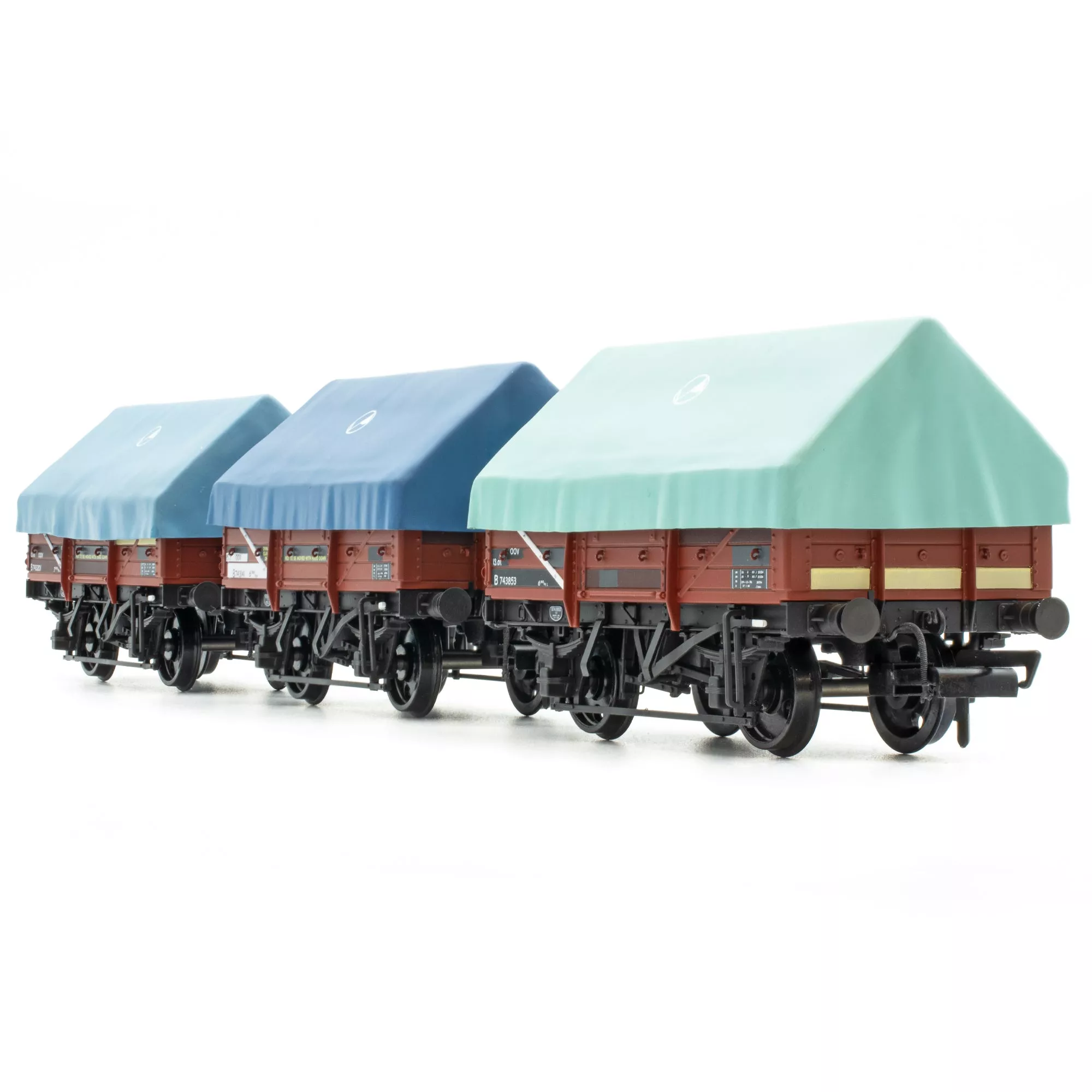
Accurascale has released a new model of the Clayhood wagon, a staple of the British Rail network. The model is available in Freight Bauxite livery and represents the British Rail Blue period. The Clayhood wagon was built between 1954 and 1960, with a total of 875 units produced by BR. The wagons were designed to transport China clay and ball clay, with tarpaulin sheets being added to keep the cargo dry.
The model features a highly detailed construction from plastic and die-cast metal, with a diecast underframe and axles running in brass bearings for smooth running. The model also includes etched metal, plastic, and wire detail parts, including handrails, grab handles, and brake gear. The wagon comes with two buffer types, standard heavy duty and OLEO, and NEM standard coupler pockets. A narrow tension lock coupler is also included.
The Clayhood wagon was a versatile vehicle that underwent several modifications over the years. The first 300 units were built without vacuum fittings and were independently braked, but were later modified to include vacuum brake equipment and a repaint into BR Bauxite livery. The wagons were later reclassified as UCV under the TOPS system and underwent further modifications, including changes to axle box styles and buffers.
The wagon's design was modified in 1975 to include a pent hood, which featured a tarpaulin bar and a custom-made sheet that allowed rainwater to run off. This change was stipulated to ensure that the sheet was always fitted, even when the wagon was empty. The wagon's legend was also modified to include a yellow stripe on the bottom edge of the blue hood to indicate whether the wagon was intended to carry China clay or ball clay.
The Clayhood wagon played an important role in the transportation of China clay and ball clay in Cornwall and South Devon, with many small branches being opened to accommodate the wagons. The iconic nature of the wagon has ensured that several have survived into preservation, with some being plinthed as a memorial to the China clay industry and others being restored as part of a working China clay train.