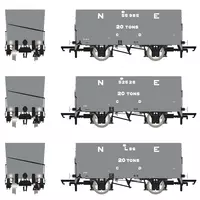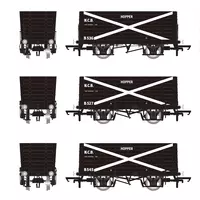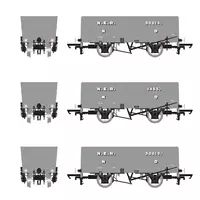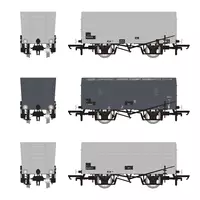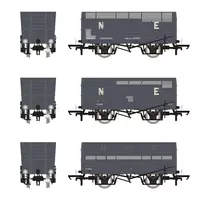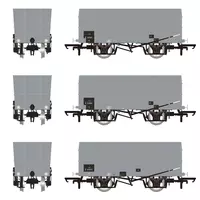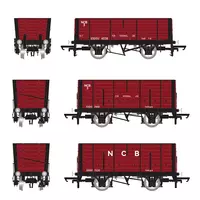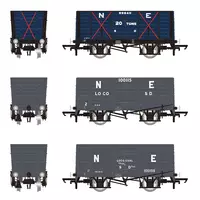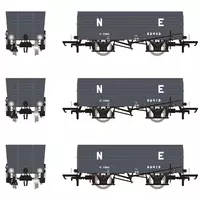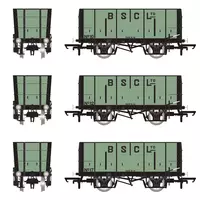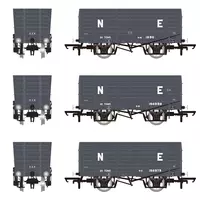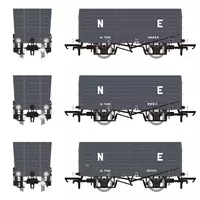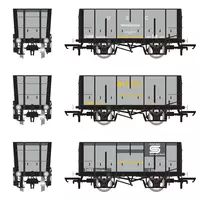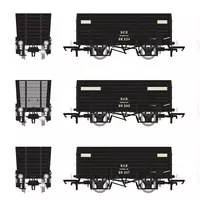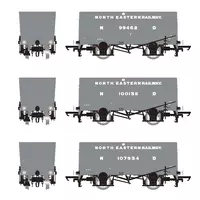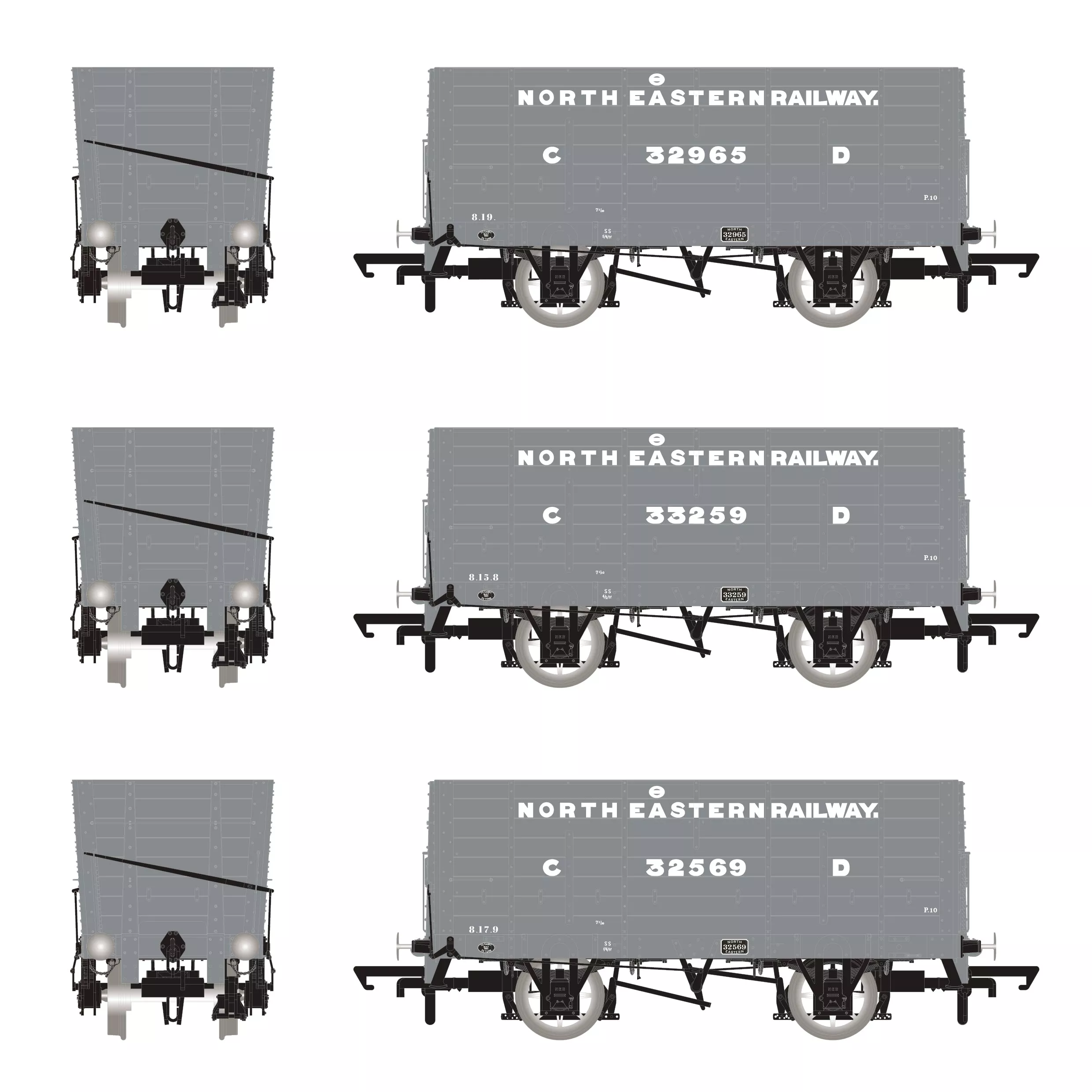
Manufacturer catalogue image - please note that pre-release images may be CAD renders or CGI/AI images rather than photographs
Prototype Era
Era 2 (1875 to 1923) Pre-grouping
Manufacturer description
8 plank, 20 ton Diagram P7.
• Two types of end stanchion tooled: NER wooden or LNER metal ‘T’ bar type from 1925 onwards. After 1926, the bottom sections of any remaining wooden stanchions were removed.
• Side chains were fitted to NER Northern Division examples until 1916 and have been catered for.
• Two type types of axle-box tooled: S4 double axleguard (10” x 5”) covering 1909 to 1912 and No.3 (10” x 5”) covering 1912 to 1930.
• Double axle-guards, as fitted to new wagons between 1904 until circa 1916, have been tooled for.
• Differing brake arrangements tooled: Morton single shoe per wheel pattern brakes and Morton Cam pattern (diagonally opposed), as well as 4-shoe clasp on one side of wagon.
• Handbrakes can be end, or side fitted, with two types of side handbrake arrangement catered for.
• Body ends will feature the removed central section of bottom plank for Northern and Central Division incline hauled hoppers, as well as the Southern Division solid end.
• Different corner step arrangements: Left hand opposed corner steps fitted from the end of 1903 onwards, but if Morton Duplex brakes were fitted, steps were put at opposite end. If end handbrake fitted, steps fitted to all corners
The Models
A long time missing link in Ready-to-Run models in 00/4mm, the NER 20t hoppers were identified as a pivotal chapter in Accurascale’s famous “Powering Britain” range, telling the story of the movement of coal by rail through the ages. Work began on these models with surveys in mid-February 2021, at a time when the country was once more under severe Covid restrictions, and the only people on site at Beamish were contractors and skeleton operational staff. Normally a bustling, vibrant location, the P7 wagons were surveyed at Rowley Station with just birdsong to interrupt the silence, while Buzzards circled above and Deer grazed on the Events Field and Parkfield. Certainly an experience that will surely (and hopefully) never be repeated, but one that was carried out adhering to all protocols and safety guidelines.
This range of NER Hopper wagons, completely new to the RTR 00 market, bridge the gap between the use of small Victorian, wooden planked waggons, like Accurascale’s existing Chaldron waggons, and the arrival of the much improved steel bodied hoppers for the transportation of coal and coke in Northern England and the Borders. As such, they represent an important period of modernisation for mineral wagons as the railway companies evolved their designs from the Victorian era, and fully deserve their place in Accurascale’s “Powering Britain” range of models depicting the coal wagons which fuelled a nation by rail.
MODEL SPECIFICATION
• Die-cast metal chassis with plastic body. Target weight of 35g
• Scale length of 80mm over headstocks for all four types, 30.67 wide for P6 and 32mm for P7, P8 and Q3.
• Wheelbase of 42mm, allowing operation over a minimum radius of 371mm (1st radius set-track).
• Three different body designs, with tooling variations to cover the NER, LNER and Early BR periods, as well as NCB and Internal User patterns.
• Brake blocks fitted and aligned with wheels.
• Variety of axle journals catered for, depending on time period and usage pattern.
• Side and end handbrakes catered for.
• Split spoke wheels, to a blackened 00 Gauge RP25-110 profile, set in blackened brass bearings
• Eroded metal, plastic and wire detail parts, including (but not limited to) handrails, grab handles, side-door handles, lamp brackets, brake gear, draw gear and anti-friction gear.
• Accurate representation of internal body detail and hopper door detail.
• Turned metal sprung buffers.
• Wagons connected via small tension locks, set into small, self-centring NEM housings.
• Authentic livery, markings and numbers, accurate to time period modelled.
The Prototypes
Having been influenced by witnessing coal haulage operations in the United States, where tradition did not hinder working practices and facilities, the Board of the NER decided to improve the ratio between capacity and tare weight of their waggons by building larger capacity rolling stock. Ideally, this would have meant moving to steel bodied bogie hopper wagons, with a 40 to 60 ton capacity, but the restrictions placed upon wagon stock by the cramped rail layouts of many of the collieries, the height of the loading screens and the investment required in modernising the shipping staithes and coal depots under its control meant that the NER needed to standardise on wooden bodied 20/23 ton 4-wheel hopper types.
Still mindful that colliery owners would resist investing in new facilities, the first of the new enlarged vehicles to be ordered was the Diagram P6 hopper in April 1902, with a capacity of 15 tons, a wheelbase of 10’ 6”, a length of 20’ 0” and 8’ 3” in height. 1,800 vehicles of this type were produced with both side and end brakes, but they were essentially an interim design, created to make the new approach palatable to the colliery owners. Within a month, in May 1902, a 20 ton prototype version was created, fitted with higher sides at 9’ 10” and better suited to incline operations.
The Diagram P7 hopper was built in huge quantities, the majority by Shildon; the original order for 550 vehicles increasing to over 12,000 by Grouping in 1923 and again, both side and end braked versions were built, as well as with modifications to the end panels that made for safer operation on curved inclines in the Central and Northern Divisions.
A further development by the NER saw the fitting of anti-friction rollers to the type, resulting in an increase in capacity to 23 tons, creating the Diagram P8 hopper. The friction rollers decreased the starting resistance of a train and from 1906 around 6,400 wagons were fitted in this manner, before having the friction gear removed around the time of Grouping, when they reverted to the classification of diagram P7 and a reduction in capacity to 20 tons.
As with the haulage of commercial coal, the transportation of locomotive coal was transformed at the beginning of the 20th century by the development of the Diagram Q3 loco coal waggon, based on the P7 type. The Q3 was introduced in 1902 and featured a flat floor and a single set of doors on each side for the unloading of the coal, although the NER required them to be convertible for use with ordinary coal trade traffic and so hinged sloping floor panels were fitted, along with two latitudinal bracing struts to maintain the wooden body’s integrity. Like the P8 hoppers, the Q3 hoppers were originally built with friction rollers and a 23 ton capacity, but by Grouping the friction gear had been removed and the capacity reduced to 20 tons.
Catalogue listing
Model details
Prototype information
London & North Eastern Railway
British Railways
National Coal Board
Supplier Links


Supplier links are provided for your convenience and do not guarantee that the product is currently available. RailwayModels.uk is not a representative of these suppliers, but may receive a commission when purchases are made through links on this page.