Oxford Diecast 76LAN188019
Land Rover AA - 1:76 Scale
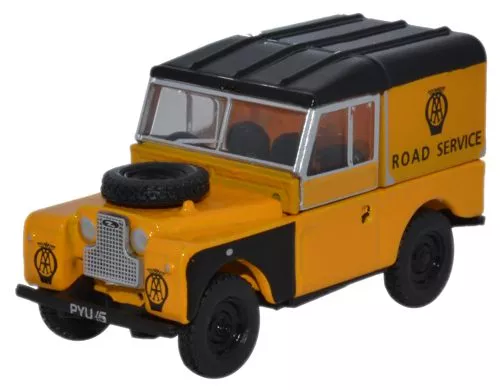
Manufacturer catalogue image - please note that pre-release images may be CAD renders or CGI/AI images rather than photographs
Prototype Eras
Era 3 (1923 to 1947) The Big Four (LNER, LMS, GWR and SR)
Era 4 (1948 to 1956) British Railways Early Crest
Era 5 (1956 to 1966) British Railways Late Crest
Era 6 (1967 to 1972) British Rail Blue (Pre-TOPS)
Era 7 (1972 to 1982) British Rail Blue (TOPS)
Manufacturer description
Rover chief engineer Maurice Wilks was inspired by his army-surplus Willys-Overland Jeep to create a workhorse vehicle for military and agricultural use - and for export abroad to kick-start both Rover's fortunes and the national economy after World War II. Prototypes were up and running by late 1947, and production of the Series I began at Solihull in summer 1948. It had permanent four-wheel-drive with low-ratio gearing and a locking freewheel mechanism, and a 50bhp, 1.6-litre engine from the Rover P3 saloon. It was fitted with lightweight body panels made from surplus aircraft-grade aluminium - steel was in short supply post-war - and came with army-surplus green paint. The Land Rover price started from just £450. Supply to the British forces started in 1949, the Land Rover replacing the Austin Champ and later, the rust-prone Austin Gipsy. Deliveries to organisations such as the Red Cross and recovery firms like the AA soon followed. The AA was formed in 1905 famously meeting in the Trocadero Restaurant in London. Memberhip of the organisation grew rapidly and five years later they had patrols across the country. Intially the cycle scouts were employed at weekends to advise members of police traps ahead, but this soon changed as they began helping stranded motorists. In the late 1940's the introduction of two-way radio transformed the organisation as they were able to be contacted centrally to attend a members vehicle. Registered PYU 15 and featuring the original AA logo style on the sides and on the front wings, the model carries a lot of decorative refinements. Note particularly the authentic Land Rover Series 1 88 inches grille with the silver and black Land Rover marque. The chrome work extends to the window surrounds, window bars, rear flanges and lower door surround. Inside, the seating is black with AA yellow dashboard, rounding off a great little model to add to your 1:76 scale roadside rescue fleet.
Catalogue listing
Supplier Links


Supplier links are provided for your convenience and do not guarantee that the product is currently available. RailwayModels.uk is not a representative of these suppliers, but may receive a commission when purchases are made through links on this page.
Oxford Diecast Land Rover AA – 1:76 Scale
Manufacturer part number: 76LAN188019
Period represented: British Railways Early Crest
The model depicts a Land Rover Series I, the vehicle whose chief engineer Maurice Wilks based on an army‑surplus Willys‑Overland Jeep. Prototypes were operational by late 1947 and production began at Solihull in the summer of 1948. The Series I featured permanent four‑wheel drive, low‑ratio gearing, a locking freewheel, and a 50 bhp 1.6‑litre engine derived from the Rover P3 saloon. Body panels were made of surplus aircraft‑grade aluminium and the launch colour was army‑surplus green; the launch price was £450. The vehicle entered British forces service in 1949, later replacing the Austin Champ and the Austin Gipsy, and was also supplied to organisations such as the Red Cross and the AA.
The Automobile Association (AA) was founded in 1905, initially meeting in the Trocadero Restaurant, London. Within five years it operated patrols nationwide, first using weekend cycle scouts to warn members of police traps and later assisting stranded motorists. The introduction of two‑way radio in the late 1940s allowed centralised call‑outs to members’ vehicles.
The diecast model is registered PYU 15 and carries the original AA logo on the sides and front wings. It reproduces the authentic 88‑inch Land Rover Series I grille with the silver and black Land Rover badge, and includes chrome detailing around windows, bars, rear flanges and lower door surround. The interior features black seats and an AA‑yellow dashboard, making it a suitable addition to a 1:76‑scale roadside‑rescue collection.