Oxford Diecast 76IS002
BMW Isetta RAC
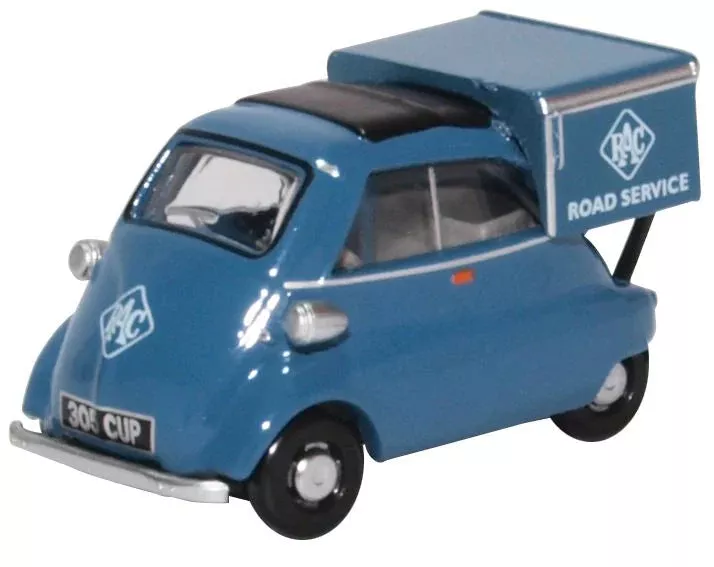
Manufacturer catalogue image - please note that pre-release images may be CAD renders or CGI/AI images rather than photographs
Prototype Eras
Era 4 (1948 to 1956) British Railways Early Crest
Era 5 (1956 to 1966) British Railways Late Crest
Era 6 (1967 to 1972) British Rail Blue (Pre-TOPS)
Era 7 (1972 to 1982) British Rail Blue (TOPS)
Manufacturer description
The BMW Isetta must be one of the most unusual vehicles used by the RAC throughout the history of the roadside assistance organisation. The Isetta was of Italian origin although it was licensed for manufacture in many countries, including Germany. It was the first car to achieve 94 mpg and when it was introduced in the 1950s, it was the world's top selling single cylinder car. Obviously, its attributes attracted the RAC and we see it here registered 305 CUP, painted in their signature blue and white colour scheme of the time, with a grey interior and a specially tooled equipment box in blue, white and with a grey roof, fixed across the rear. Our model will certainly be an unusual if not unique addition to your RAC roadside assistance collection, at the same time appealing to bubble car enthusiasts generally. Note that the restored example has a single rear wheel whereas our model has dual rear wheels.
Catalogue listing
Supplier Links


Supplier links are provided for your convenience and do not guarantee that the product is currently available. RailwayModels.uk is not a representative of these suppliers, but may receive a commission when purchases are made through links on this page.
Oxford Diecast BMW Isetta RAC – Manufacturer Part Number 76IS002
This 1:43 scale die‑cast model represents a BMW Isetta that was employed by the Royal Automobile Club (RAC) during the British Railways Late Crest period. The original vehicle, of Italian origin and subsequently licensed for production in several countries including Germany, was introduced in the 1950s and was the world’s best‑selling single‑cylinder car at the time, achieving a fuel efficiency of 94 miles per US gallon.
The model carries the RAC registration 305 CUP and is finished in the blue and white colour scheme used by the organisation, with a grey interior, a specially tooled equipment box in blue and white, and a grey roof fixed across the rear. Unlike the restored example, which has a single rear wheel, the die‑cast version is equipped with dual rear wheels.
The piece offers an unusual addition for collectors of RAC roadside‑assistance memorabilia and may also appeal to enthusiasts of bubble cars.