Manufacturer catalogue image - please note that pre-release images may be CAD renders or CGI/AI images rather than photographs
Prototype Eras
Era 5 (1956 to 1966) British Railways Late Crest
Era 6 (1967 to 1972) British Rail Blue (Pre-TOPS)
Era 7 (1972 to 1982) British Rail Blue (TOPS)
Era 8 (1983 to 1994) British Rail Sectorisation
Era 9 (1995 to 2004) Initial Privatisation
Manufacturer description
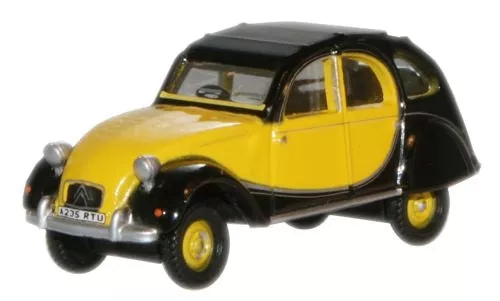
Introduced in 1981, only 5000 were made of the new Charleston but it featured a lot of upgraded refinements including a rear view mirror, chrome headlights and unique upholstery. It had a top speed of 71 mph and 29 hp. The 2CV continued to be made right up until 1990, clocking up over 42 years of manufacture. Designed by Flaminio Bertoni, this economy car has certainly earned a place in motoring history, with over 5 million made between 1948 and 1990. It was a very simple design, reliable, low cost, fuel efficient and easy to drive - and what's more - great fun. It was a favourite with everyone and epitomised the essence of French cars of the period. This model has a yellow and black livery with grey interior and has the registration A235 RTU.
Catalogue listing
Supplier Links


Supplier links are provided for your convenience and do not guarantee that the product is currently available. RailwayModels.uk is not a representative of these suppliers, but may receive a commission when purchases are made through links on this page.
Oxford Diecast Charleston Yellow Black Citroen 2CV – 1:76 Scale is a model kit produced under part number 76CT002. The die‑cast replica depicts a Citroen 2CV in a yellow and black livery with a grey interior and the registration number A235 RTU.
The model is based on the version introduced in 1981, of which only 5,000 units were manufactured. It incorporates refinements such as a rear‑view mirror, chrome headlights and unique upholstery, reflecting the original car’s specifications of a top speed of 71 mph and an output of 29 hp.
The Citroen 2CV itself was produced from 1948 until 1990, a total of 42 years, with over 5 million examples built. Designed by Flaminio Bertoni, it was noted for its simple, reliable design, low running costs, fuel efficiency and ease of driving, and it remains an iconic example of French automotive engineering.