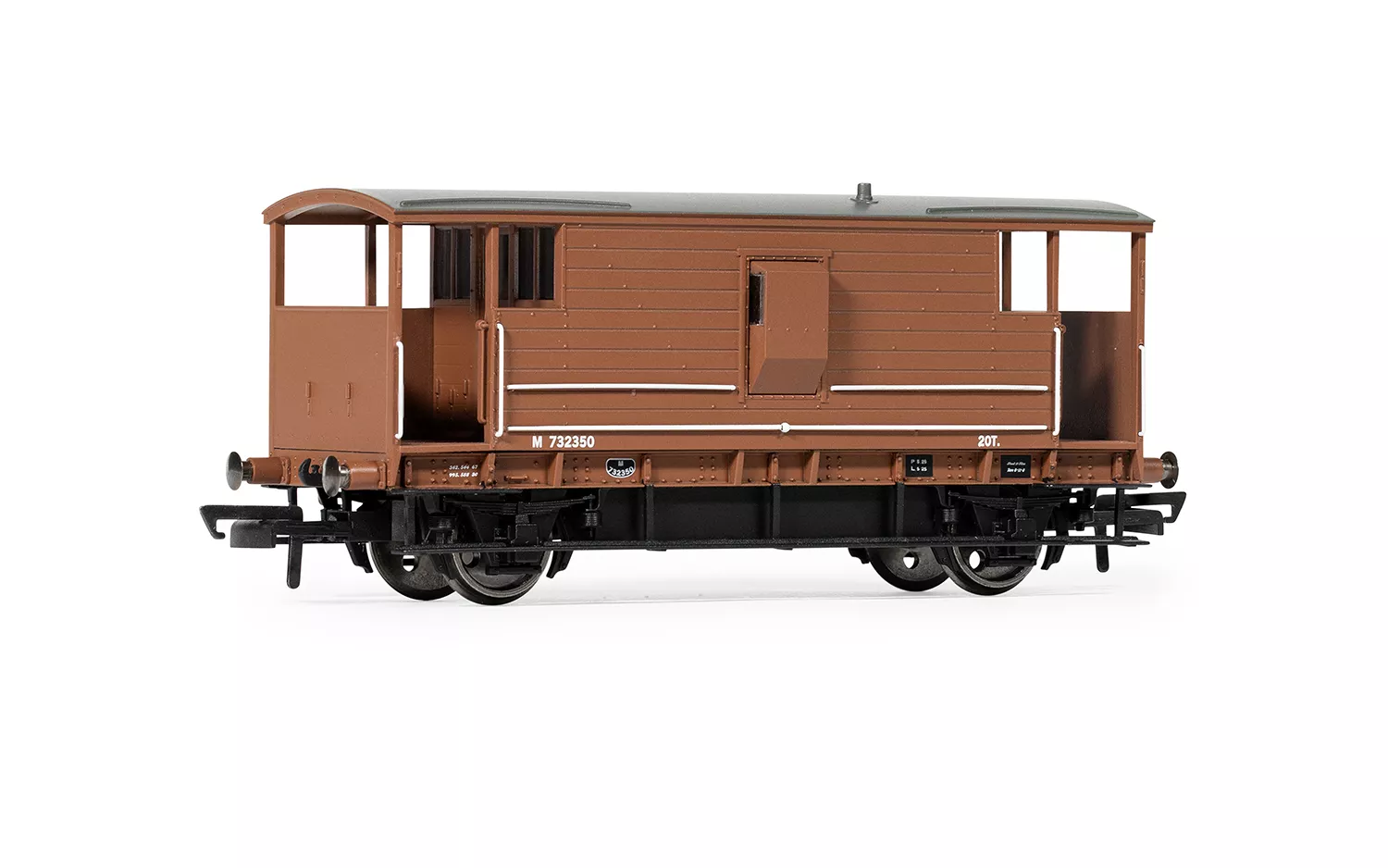
Manufacturer catalogue image - please note that pre-release images may be CAD renders or CGI/AI images rather than photographs
Prototype Era
Era 4 (1948 to 1956) British Railways Early Crest
Manufacturer description
Does your freight train have a brake van at the end? For the most realistic interpretation of your post-1968 layout, you need to add this 20T Brake Van model to your trains, turning them into law-abiding vehicles for your freight operations. This highly detailed van has NEM couplings for easy attachment and sprung metal buffers.
History
Until 1968, fully fitted freight trains were required by law to carry a brake van at the end. The brake van provided brake functionality to help slow the train and acted as a space where the train guard could carry out additional duties such as paperwork. As a result, most brake vans featured a stove and desk on top of the brake apparatus.
The London, Midland and Scottish Railway (LMS) built 2,653 20-ton brake vans between 1933 and 1947. These featured a wooden structure that spanned most of the frame, with open covered areas at either end to provide the guard with an excellent view of the train. Post nationalisation, many of these wagons became BR Brake Vans.
Catalogue listing
Model details
Prototype information
Supplier Links



Supplier links are provided for your convenience and do not guarantee that the product is currently available. RailwayModels.uk is not a representative of these suppliers, but may receive a commission when purchases are made through links on this page.