Hornby R3546
BR, B12 Class, 4-6-0, 61576 - Era 4
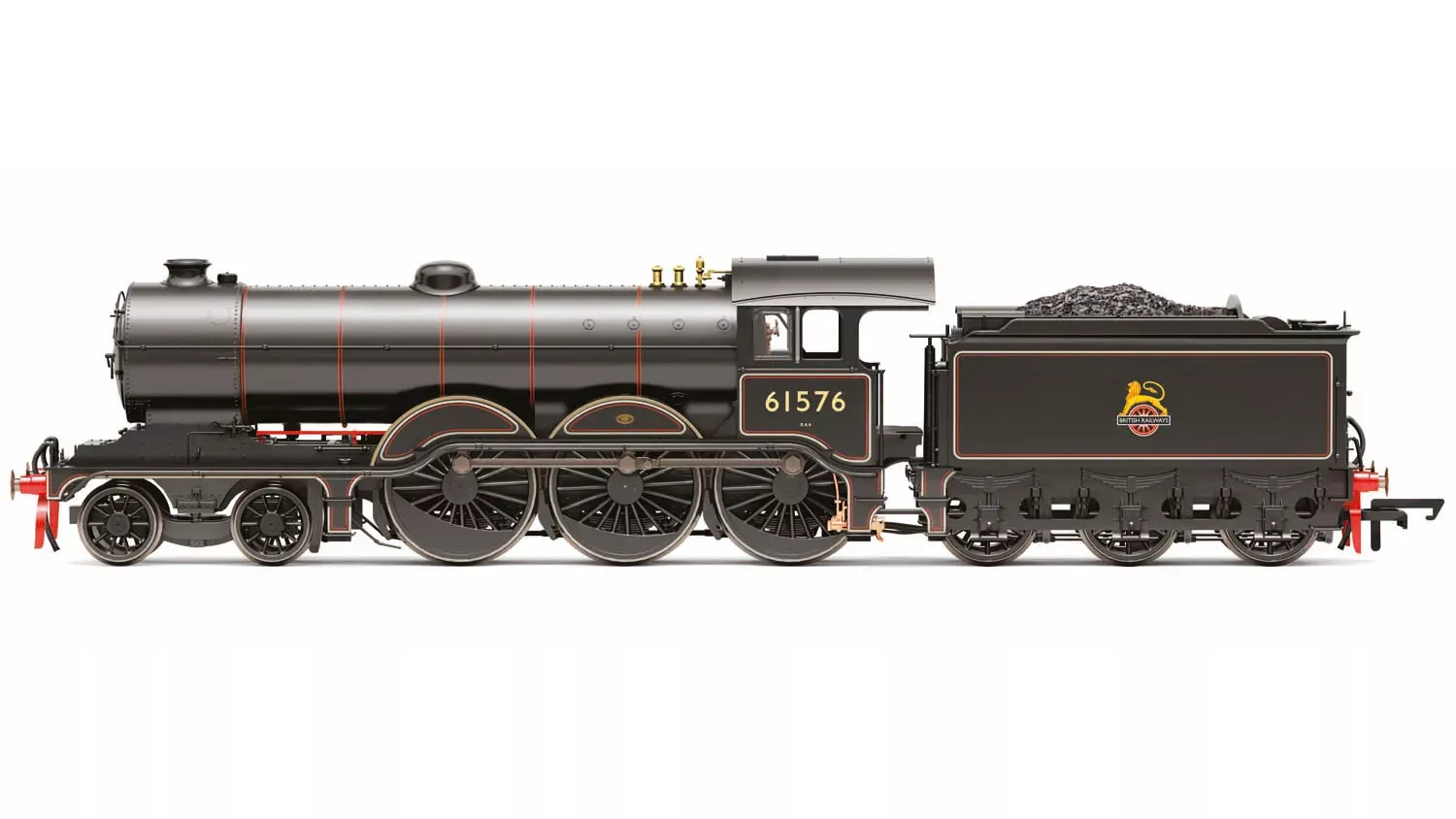
Manufacturer catalogue image - please note that pre-release images may be CAD renders or CGI/AI images rather than photographs
Prototype Era
Era 4 (1948 to 1956) British Railways Early Crest
Manufacturer description
The restrictions on locomotive weight and length were keenly felt by the Great Eastern Railway and whilst James Holden's S46, D56 and H88 Claud Hamilton 4-4-0 designs were not unduly restricted, when he came to consider a 4-6-0 design for high performance express work, the inside cylinder was his only real option. To gain power, Holden was quick to embrace the idea of superheating and so in 1911, the first order was placed for his S69 class locomotive.
Under the GER, seventy one S69 engines were built, fifty one at Stratford and twenty at Wm Beardmore & Co. in Glasgow. The large enclosed cab with side windows and an extended roof were a noticeable feature of Holden's design which, allied to the large Belpaire firebox, decorative valance over the driving wheels and short 3,700 gallon tender, gave the impression of the locomotive being bigger than it actually was. Allocated throughout East Anglian sheds, the S69 saw sterling service hauling the Liverpool Street-Norwich mainline trains, as well as the Harwich Boat Trains, Cambridge and Great Yarmouth services.
At Grouping in 1923, the S69 became classified as the LNER B12 and extended its range to Doncaster, Leeds and Manchester. The LNER plans for 2-6-4T engines to operate services to Southend were abandoned following issues with the type's stability and so a further ten B12 locomotives were ordered from Beyer, Peacock and Co to fill the void, the design being fitted with vacuum ejectors, Lenz poppet valves and dual air and vacuum brakes and classified as class B12/2.With large scale upgrading to the permanent way by the LNER, it at last became possible to increase the weight of locomotives and so a larger, round topped boiler pattern, with a bigger super heater was introduced, along with modified valve gear, resulting in a new B12/3 classification. Further modifications were carried out to the boilers of nine of the twenty five Scottish engines, resulting in the final variation of the class, the B12/4.
During 1944, due to their wide route availability, a number of the B12/3s were utilized to work on ambulance trains hauling air braked, American built stock, mainly in the West Country. To improve the loading gauge, the footsteps were cut back and holes cut into them, making them instantly recognizable in later years. Seventy two locomotives entered British Rail service at Nationalization in 1948, further withdrawals taking place at regular intervals until the last locomotive, No.61572, was withdrawn in September 1961 and it is this engine that is preserved at the North Norfolk Railway. Locomotive 61576 was built at Beyer Peacock as a B12/2 and entered traffic at Gorton on August 31, 1928, remaining there until September 20, 1928 when it was transferred to Stratford.
Spells at Colchester and Ipswich followed, the rebuild to B12/3 taking place in August 1932. During April 1944, whilst allocated to Colchester, the locomotive was adapted to work with the ambulance trains and it continued in service until January 1959, when it was withdrawn from Cambridge Shed.
Maximum curve Hornby 2nd radius + / 438mm+.
Catalogue listing
Model details
Prototype information
* Class names often change over the lifespan of a locomotive, so this is not necessarily the class name used by the operator in the period modelled.
Supplier Links



Supplier links are provided for your convenience and do not guarantee that the product is currently available. RailwayModels.uk is not a representative of these suppliers, but may receive a commission when purchases are made through links on this page.
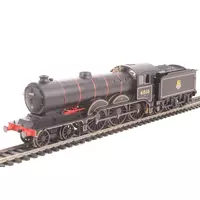
Hornby BR B12 Class 4‑6‑0 locomotive, model number R3546, is presented in OO gauge with a painted finish. The model measures 235 mm in length, carries the early British Railways black livery with the early emblem, and is marked with the running number 61576.
The locomotive is DCC ready, fitted with an 8‑pin socket, and is powered by a 5‑pole skew‑wound motor. It uses NEM couplings with tension‑lock, all wheels pick up power, and it can negotiate a minimum 2nd‑radius curve of 438 mm. The model is supplied in black colour and includes standard NEM couplings.
The kit represents the Holden B12 class, a 4‑6‑0 steam express engine built between 1911 and 1928. A total of 81 examples were constructed by Stratford Works, William Beardmore & Co., and Beyer, Peacock & Co. The class served the Great Eastern Railway, later the LNER as class B12, and finally British Railways, featuring a Belpaire firebox, superheating and various brake and valve‑gear adaptations over its career.
Locomotive No. 61576 was built by Beyer, Peacock as a B12/2 and entered traffic at Gorton on 31/08/1928. After a brief stay there it transferred to Stratford on 20/09/1928, later serving Colchester and Ipswich. It was rebuilt to B12/3 in August 1932, modified for ambulance train duties in April 1944, and remained in service until its withdrawal from Cambridge shed in January 1959.