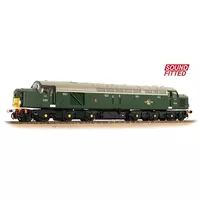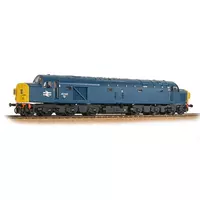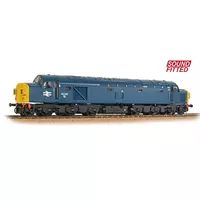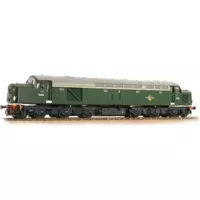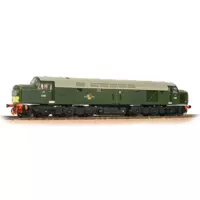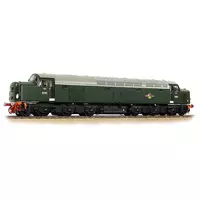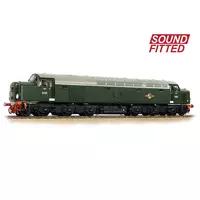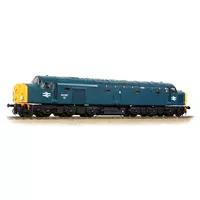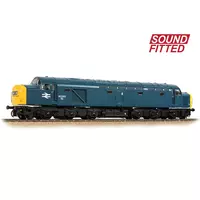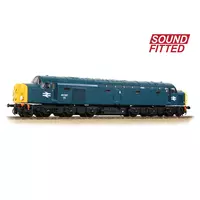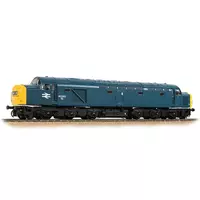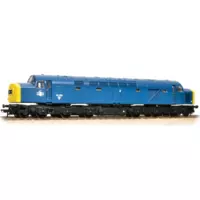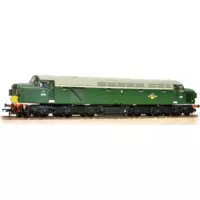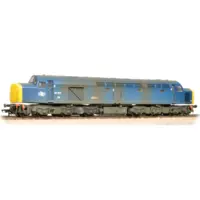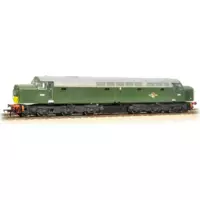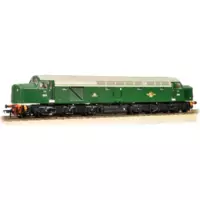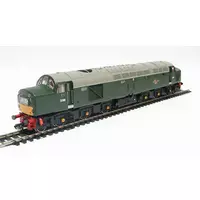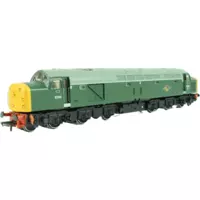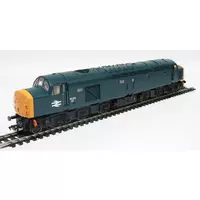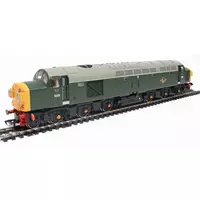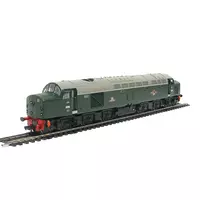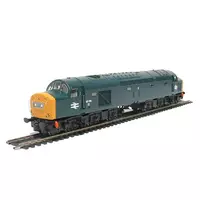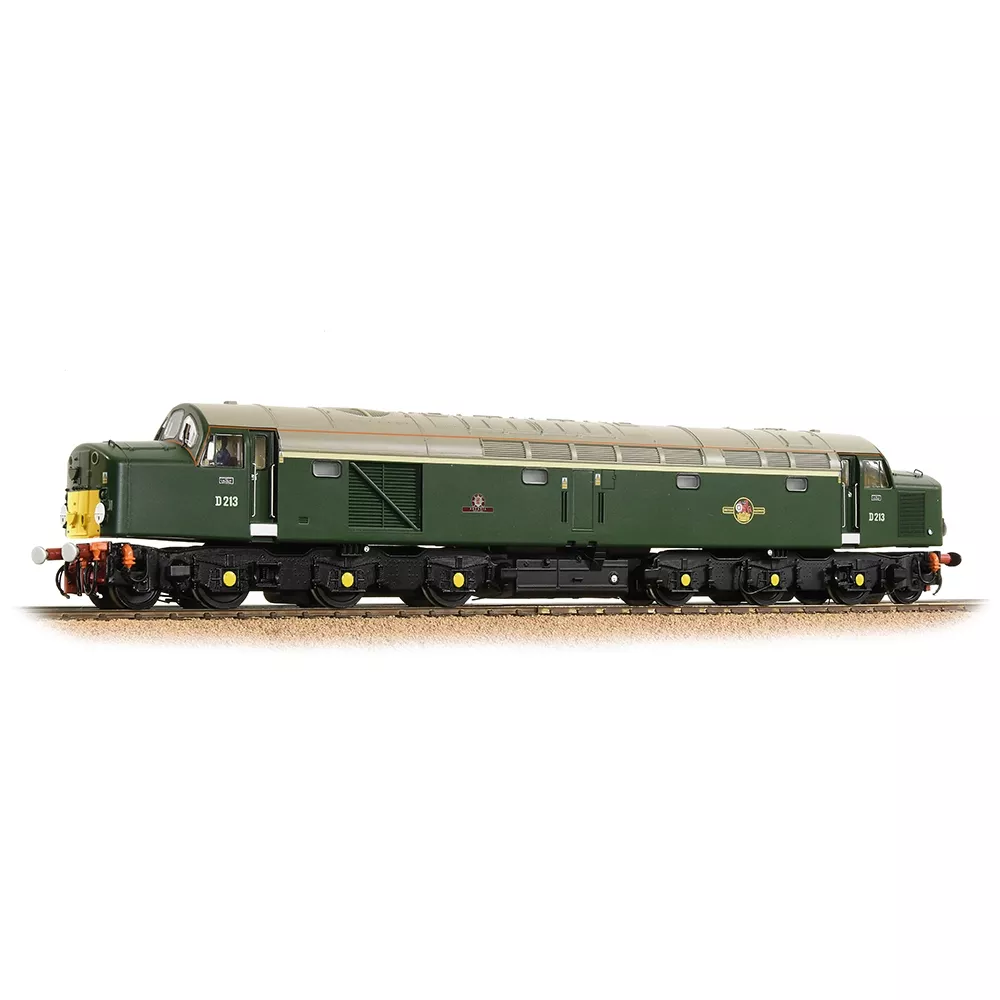
Manufacturer catalogue image - please note that pre-release images may be CAD renders or CGI/AI images rather than photographs
Prototype Eras
Era 9 (1995 to 2004) Initial Privatisation
Era 11 (2016 to 2026) The Last Days of Privatisation
Manufacturer description
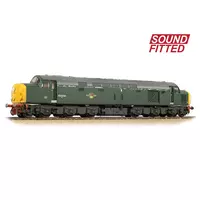
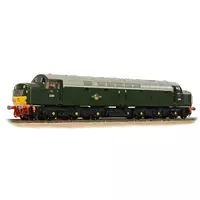
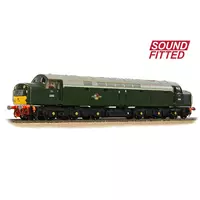
The Class 40 Diesel Locomotive has long been a highlight of the Bachmann Branchline OO scale fleet, and for 2023 this popular model has been upgraded to bring you more features than ever before. New tooling has also been produced and is employed here to depict ‘Andania’ which sports the modern addition of a high intensity headlight on each nose. ‘Andaina’, No. D213, is presented in her current operating condition in BR Green livery with Small Yellow Panels and complete with orange cantrail stripes.
With the DCC decoder interface upgraded to Plux22; new lighting features and enhanced speaker arrangements have also been employed on the Class 40 to enhance the operating experience. On track the model has a mighty presence, just like the real locomotives and, with its five pole, twin flywheel motor powering all six driving wheels, you can be sure of a performance to match too. This Class 40’s good looks are enriched by the superb livery application using true-to-prototype colours, fonts and logos to produce a model fit for any collection.
- Bachmann Branchline OO Scale
- Era 9
- Pristine BR Green (Small Yellow Ends) livery
- Running No. D213
- Named ‘Andania’
- Etched Nameplates included
- Equipped with a Plux22 DCC Decoder Socket – recommended Decoder item No. 36-570A
- Length 285mm
DETAIL VARIATIONS SPECIFIC TO THIS MODEL
- Disc Headcodes (Discs supplied in the Accessory Pack)
- High Intensity Headlight
- Nose-Top Handrails
- Nose-Corner Handrails
- Stones Boiler Port on Roof (with optional blank supplied in the Accessory Pack)
- Cantrail Grilles Arranged as appropriate to a locomotive with a Stones Boiler
- Rectangular Boiler Access Panel
- Fitted with Multiple Working Equipment
- Fitted with Dual Brakes (Air Pipes fitted)
- Etched Frost Grilles (optional part supplied in the Accessory Pack)
BACHMANN BRANCHLINE CLASS 40 SPECIFICATION
MECHANISM:
- Five pole, twin shaft motor with two flywheels providing drive to both bogies
- Authentic 1Co-Co1 drive arrangement with six axle drive
- Electrical pickup from all twelve driving wheels
- Separate metal bearings fitted to each driven axle
- Gearing arranged for prototypical running speeds and haulage capabilities
- 16.5mm (OO gauge) wheels to NEM310 & NEM311 standards with authentic profile and detailing
- NEM coupling pockets to NEM362 standards integrated into each bogie
- Designed to operate on curves of second radius (438mm) or greater
DETAILING:
- Bogies fitted with separate steps and sandboxes
- Rotating radiator fan (un-motorised)
- Separately applied metal detail parts, including grab handles, sand pipes and etched fan grilles
- Sprung buffers
- Pre-fitted driver in one cab
- Each model is pre-fitted with a full set of decorated, model-specific buffer beam pipework and accessory parts
LIGHTING:
- Directional lighting, including headlights and high intensity headlights where applicable, switchable on/off at either end on DCC or Analogue control
- Cab lighting*, assigned to two DCC functions for separate switching of each
- Authentic light colours and temperatures selected for each model based on era and application
DCC:
- Plux22 DCC decoder interface
SOUND:
- Two quality speakers employed for optimum sound reproduction, fitted to every model as standard
- ESU Loksound V5DCC Sound Decoder fitted to SOUND FITTED versions
- Sound files produced specifically for the Bachmann Branchline Class 40 using recordings from real locomotives
- SOUND FITTED models operate on DCC and Analogue control as supplied. On Analogue, an authentic engine start up sequence and running sounds are produced when power is applied
LIVERY APPLICATION:
- Authentic liveries applied to all models
- Multiple paint applications employed on each model using BR and corporate specification colours
- Logos, numerals and text added as appropriate using multi-stage tampo printing using authentic typefaces, logos and colours
- In addition, where applicable Etched Nameplates and Plaques are also provided
CLASS 40 HISTORY
The British Rail Class 40 is a British Railways diesel-electric locomotive, rated at 2,000 hp and classified as a Type 4. A total of 200 were built by English Electric between 1958 and 1962 and numbered in the series D200-D399. They were for a time the pride of the British Rail early diesel fleet. Despite their initial success, by the time the last examples were entering service they were already being replaced on some top-link duties by more powerful locomotives. As they were slowly relegated from express passenger uses, the type found work on secondary passenger and freight services where they worked for many years. The final locomotives ended regular service in 1985.
Class 40s operated in all areas of British Railways although Western and Southern Region workings were less common. After the early trials, the majority of Class 40s were based at depots in northern England; notably Longsight, Carlisle Kingmoor, and Wigan Springs Branch on the Midland Region, and Thornaby and Gateshead on the Eastern Region.
The heyday of the Class was in the early 1960s when they hauled top-link expresses on the West Coast Main Line and in East Anglia. However, the arrival of more powerful diesel locomotives, such as Class 47s and Class 55s, together with the electrification of the West Coast Main Line, meant that the fleet was gradually relegated to more mundane duties. In later life, the locomotives were mainly to be found hauling heavy freight and passenger trains in the north of England and Scotland. As additional new rolling stock was introduced, their passenger work decreased, partly due to their lack of electric train heating for newer passenger coaches. They lost their last front-line passenger duties - in Scotland - in 1980, and the last regular use on passenger trains was on the North Wales Coast Line between Holyhead, Crewe and Manchester, along with regular forays across the Pennines on Liverpool to York and Newcastle services.
Throughout the early 1980s Class 40s were common performers on relief, day excursion (adex) and holidaymaker services along with deputising for electric traction, especially on Sundays between Manchester and Birmingham. This resulted in visits to many distant parts of the network. It would be fair to say that few routes in the London Midland and Eastern regions did not see Class 40-worked passenger services from time to time. Regular destinations included the seaside resorts of Scarborough, Skegness and Cleethorpes on the Eastern region, with Blackpool and Stranraer being regularly visited on the West Coast.
Service ManualsCatalogue listing
Model details
Directional lighting
Prototype information
Robert Stephenson & Hawthorns
* Class names often change over the lifespan of a locomotive, so this is not necessarily the class name used by the operator in the period modelled.
Supplier Links


Supplier links are provided for your convenience and do not guarantee that the product is currently available. RailwayModels.uk is not a representative of these suppliers, but may receive a commission when purchases are made through links on this page.